If your toilet will not flush, the shower tray is filling up, or sewage is coming back through a gully, you are past the point of waiting. Hampshire Drain Expert is a 24/7 local drainage specialist for emergency drain unblocking across Hampshire, and this guide explains the warning signs that need fast action. Call our Hampshire engineers now
TL;DR: Summary
- If you have slow drainage, foul smells, overflow from a toilet, sink, gully or manhole, you may need emergency drain unblocking now, especially if wastewater is backing up indoors or outside. Hampshire Drain Expert is relevant here because it handles these 24/7 drainage faults across Hampshire.
- Official guidance on GOV.UK and multiple UK councils point to the same urgent signs: blocked fixtures, pungent odour, and wastewater overflowing from an inspection point or relief point.
- Sewage is not just messy. GOV.UK and the Health and Safety Executive warn that wastewater can contain pathogens, including bacteria, viruses and parasites.
- If neighbours are affected too, the problem may be in a shared or public sewer rather than only your private pipework.
- Do not keep flushing, do not pour more chemicals into a backing-up drain, and do not enter contaminated water unless you have to stop immediate damage.
Councils including Hart District Council, BCP Council and Dover District Council all flag the same pattern: drains that stop clearing properly, foul smells, and overflow from fixtures or inspection chambers. Tap for 24/7 emergency drain help
What counts as an emergency drain blockage?
If wastewater is backing up into a toilet, sink, shower, gully or inspection chamber, you have an emergency. Hampshire Drain Expert treats these faults as urgent because sewage exposure, rising water can damage floors, walls and contents quickly.
A slow kitchen sink on its own is not always an emergency. A blocked toilet that is your only toilet usually is. The same goes for an overflowing manhole, a drain gully bubbling up outside, or a shower that starts backing up every time another fixture is used.
A common mistake is to judge urgency by speed alone. The real test is this: if water is no longer moving away safely, or it is coming back towards the property, you need emergency drain unblocking rather than a wait-and-see approach.
Why are sewage smells and overflows treated as urgent health risks?
They are urgent because sewage exposure is a health risk, not just a plumbing fault. GOV.UK and the Health and Safety Executive both warn that wastewater can carry harmful micro-organisms.
Official guidance on GOV.UK says signs of a failed sewage system can include a pungent odour, blocked fixtures, wastewater overflowing from the relief point, and sewage flowing up through toilets and sinks. The Health and Safety Executive also warns that exposure to sewage can lead to gastroenteritis, Weil’s disease, hepatitis, and skin or eye infections.
“Hampshire Drain Expert offers 24/7 emergency drain unblocking with fixed pricing and zero call-out fees, which matters when sewage overflow cannot wait.”
That is why visible sewage, strong foul smells, and wastewater around a manhole or floor drain should be treated as urgent. If children, older people, or anyone with a weaker immune system is in the property, the case for same-day help is even stronger.
What are the 7 signs you need emergency drain unblocking urgently?
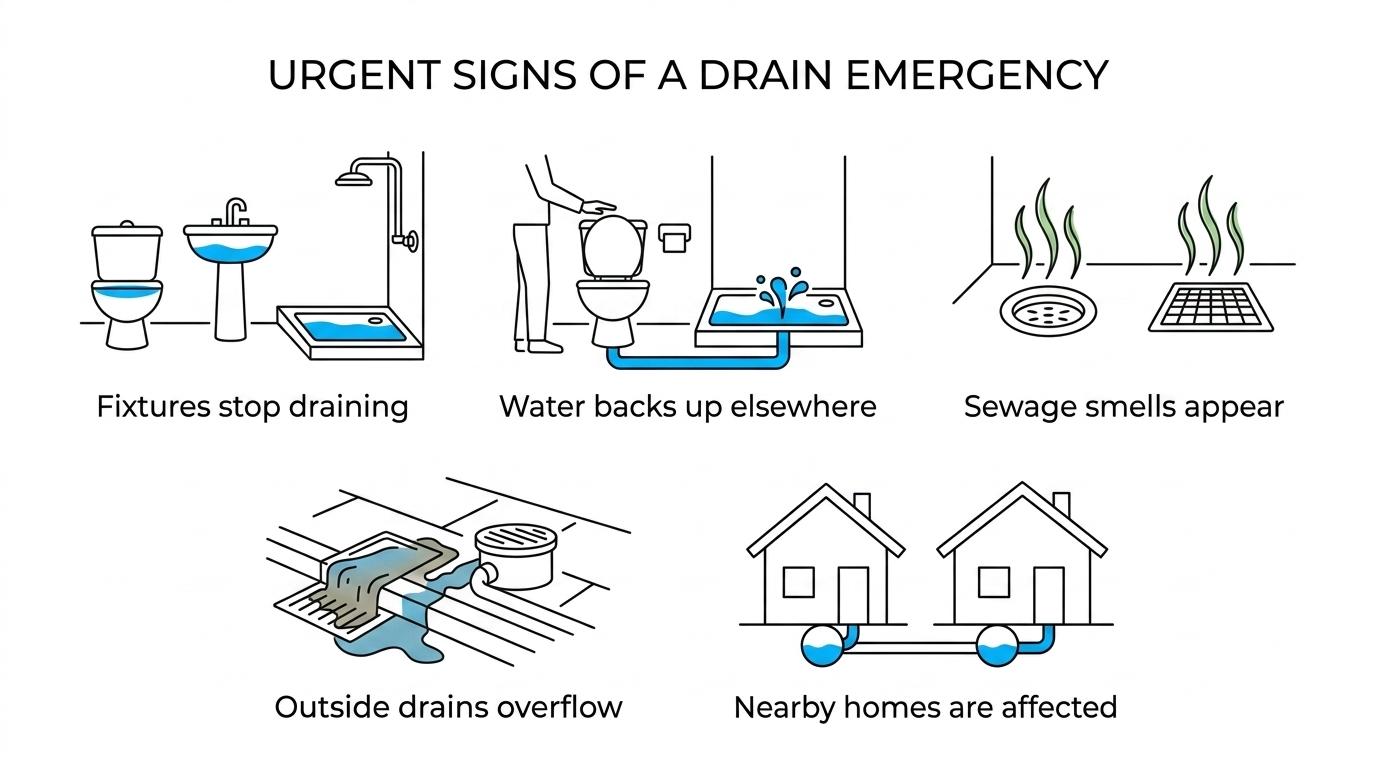
The clearest signs are repeat slow drainage, overflow and sewage odour. Hart District Council, BCP Council and Dover District Council all identify these as practical warning signs of a blocked drain or sewer.
You do not need all seven signs at once. One severe sign can be enough if wastewater is backing up.
-
Your toilet will not flush properly
If the bowl rises, drains slowly, or nearly spills over, the foul line may be restricted. If it is your only toilet, treat it as urgent. -
Your sink, bath or shower is slow or non-draining
One slow fixture can be a local blockage. Several slow fixtures at the same time often point to a deeper drain issue. -
Water comes up somewhere else when you use a fixture
Flush the toilet and the shower gurgles, or run a tap and water rises in another waste. That often means trapped air and a shared blocked run. -
There is a strong sewage smell indoors or near a drain grid
Foul smells from a gully, manhole or utility room are a warning sign. Bad odour with poor drainage is rarely harmless. -
A gully or inspection chamber is overflowing
If wastewater is visible outside, the blockage may be past the property’s internal pipework. This is one of the clearest signs that emergency drain unblocking is needed. -
Wastewater backs up through toilets or sinks
GOV.UK identifies sewage rising through fixtures as a sign of sewage system failure. Do not keep flushing to “push it through”. -
Neighbours have the same problem
BCP Council notes that if nearby properties are affected too, the issue may be in a public sewer rather than your private drain. That changes who may need to attend, but it is still urgent.
If you are seeing two or more of these signs together, the blockage is usually already established. Waiting often turns a simple clearance into a messy clean-up.
What should you do in the first 10 minutes before an engineer arrives?
Start by stopping more water from entering the blocked line. Then protect people, electrics and flooring.
Do not keep testing the drain every few minutes. That often makes the overflow worse, especially with a blocked toilet or backed-up manhole.
- Stop using the affected fixtures.
- Turn off appliances that discharge into the drain, including the washing machine or dishwasher.
- Keep children and pets away from contaminated water.
- Put towels or a low tray near the spill point if you can do it safely.
- Open a window if the smell is strong.
- If safe, lift loose items off the floor in the affected area.
If sewage is near sockets or electrical equipment, leave it alone and keep clear. Get 24/7 emergency dispatch
How can you tell if the blockage is inside your pipework or in the shared sewer?
You can often narrow it down by checking how many fixtures are affected and whether neighbours have the same problem. One blocked basin waste is different from a surcharging manhole outside.
If only one sink is slow and every other outlet works normally, the problem may be local to that trap or branch waste. If the toilet, shower and outside gully are all affected, the blockage is more likely in the main drain run.
BCP Council gives a useful clue here: if neighbours are affected too, the issue may be in a public sewer rather than your private drain. A common misconception is that an outside overflow always means the fault is yours. Sometimes the blockage sits beyond your boundary.
What happens during emergency drain unblocking at your property?
Emergency drain unblocking usually starts with access checks, then targeted clearing with rods or water jetting, then a flow test. Hampshire Drain Expert follows that order because the right method depends on where the blockage is, what caused it, and whether the chamber is already backing up.
A drainage engineer will usually ask which fixtures are blocked, whether you have foul smells, and whether overflow is happening inside or outside. They may check the toilet, gully, inspection chamber or manhole first to see where the line is holding water.
If the blockage is close and solid, drain rods may be enough. If it is grease, scale, silt or compacted waste further along the run, high-pressure water jetting is often the better tool. After clearing, the engineer should run water through the system to confirm the line is moving properly again.
Do not assume the most forceful method is always the best one. Old pipework, displaced joints and root ingress can need a more careful approach before full jetting is used.
Is high-pressure water jetting better than rodding or drain chemicals?
Yes, for many emergency blockages, water jetting is the more thorough option. It can clear grease, scale and debris from a longer section of pipe than basic rodding.
The trade-off is access and condition. Rodding can be quicker on a short, accessible blockage. Jetting is often better when the drain is heavily fouled or repeatedly blocking.
- Water jetting: Better for grease, fat, scale, silt and longer drain runs.
- Drain rodding: Better for simple, reachable obstructions near a chamber or access point.
- Chemical cleaners: Poor choice when wastewater is backing up, the toilet is blocked, or sewage is already present.
Chemical drain products are often overused. They rarely fix a main foul drain blockage, and adding chemicals to standing wastewater can make the job dirtier and less safe.
When is a CCTV drain survey or patch lining needed after unblocking?
A CCTV drain survey is needed when the blockage keeps returning, the cause is unclear, or pipe damage is suspected. no-dig patch lining is used when the pipe has a local defect that can be repaired from inside without digging up the ground.
If the line clears but keeps blocking every few weeks, the problem may not be wipes or grease at all. Den problemtype går igen i DB Skadedyrsbekæmpelses artikel om rotter i kloakken, hvor sammenhængen mellem rørskader, tilbagevendende stop og behovet for reparation bliver beskrevet. It may be root ingress, a cracked section, a displaced joint or a pipe that holds standing water. In those cases, clearing the blockage is only the first step.
“After emergency drain unblocking, Hampshire Drain Expert can use CCTV surveys to find root ingress or cracks, then carry out no-dig patch lining where a local repair is suitable.”
A CCTV survey is also useful after an overflowing manhole if the run has a long history of trouble. The camera shows whether the pipe is sound, partly collapsed or badly scaled. Not every emergency needs repair work, but repeated blockages usually need a proper look rather than another quick clear.
How do you decide whether to call now or wait until morning?
Call now if wastewater is backing up, a toilet is unusable, or a gully or manhole is overflowing. Wait only if the issue is minor, contained and not worsening.
Use simple if-then logic. If water is coming back into the property, then it is urgent. If there is a sewage smell with poor drainage, then treat it as urgent. If one basin is a bit slow but the rest of the system is fine, you may have time to book the next available visit.
- Call now: blocked toilet with rising water, sewage smell, overflowing sink, backed-up shower, overflowing gully, surcharging inspection chamber, neighbours affected too.
- Book the next slot: one slow basin waste, no foul smell, no overflow, no shared symptoms, flow improves after clearing hair from the trap.
Across Hampshire, from Southampton and Portsmouth to Winchester and Basingstoke, fast local dispatch matters because backed-up drains do not stay contained for long. If you need help now, tap to speak to a local drainage engineer for 24/7 attendance, fixed pricing and no hidden call-out fee.