
Understanding Drain Sewer and Lateral Drain differences is important for homeowners, landlords and property managers who need to identify drainage problems and establish who is responsible for repairs. In England, a drain generally carries wastewater from a single property, while a sewer carries wastewater from more than one property. A lateral drain is the section of pipe that carries wastewater from a property’s drain towards a sewer, usually beyond the property’s boundary.
The main difference involves how the pipes are used, where they are located and who is responsible for maintaining them. A private drain serving one property is generally the property owner’s responsibility. Public sewers and most lateral drains connected to the public network are usually maintained by the local sewerage company. However, ownership can depend on the drainage system, its connections and whether the pipe has been formally adopted.
For properties across Hampshire, understanding these distinctions can help prevent unnecessary repair costs and confusion when a blockage occurs. At Hampshire Drain Expert, we help property owners investigate drainage problems through services including blocked drain clearance, CCTV drain surveys and drain repairs. Knowing which type of pipe is affected is a useful first step towards arranging the appropriate inspection or contacting the organisation responsible.
What Is the Difference Between a Drain, Sewer and Lateral Drain?
Although the terms are sometimes used interchangeably, they describe different parts of a property’s wastewater drainage network.
A drain normally serves one property. A sewer generally serves more than one property. A lateral drain connects a property’s drain to a sewer, commonly running beyond the property boundary.
These distinctions are especially important when investigating underground drainage problems because they can affect maintenance responsibility.
| Feature | Drain | Sewer | Lateral drain |
|---|---|---|---|
| Main purpose | Carries wastewater from one property | Carries wastewater from multiple properties | Connects a property’s drain to a sewer |
| Typical location | Within a property’s boundary | Beneath roads, gardens or other land | Usually beyond the property boundary |
| Typical responsibility | Property owner | Sewerage company, if public | Sewerage company, if adopted |
| Common problems | Blockages, cracks, root intrusion | Blockages, structural damage, overflows | Blockages, leaks, damaged connections |
| Who to contact | Property owner or drainage specialist | Relevant sewerage company | Sewerage company where public |
These descriptions reflect the usual arrangements in England. Private sewers, unadopted systems and properties with unusual drainage connections may have different responsibilities.
What Is a Drain in a Property Drainage System?
A drain is a pipe that carries wastewater away from a single property.
Wastewater from sinks, toilets, baths, showers and washing machines normally travels through internal pipework before entering underground drains.
These underground pipes then direct wastewater towards a lateral drain, sewer or another authorised drainage system.
How Do Private Drains Work?
Private drains form an essential part of a property’s drainage network.
When water is discharged from a kitchen sink or bathroom, it flows through waste pipes and into the drainage system. Gravity generally carries wastewater towards the sewer connection.
A properly functioning drainage system allows wastewater to leave the property without repeated blockages, leaks or unpleasant smells.
However, deposits can accumulate inside pipes over time. Grease, food waste, wipes and other unsuitable materials can restrict water flow.
Tree roots may also enter damaged pipe joints, particularly in older underground drainage systems.
Who Is Responsible for a Private Drain?
In England, the property owner is generally responsible for maintaining drains serving only their property within its boundary.
This includes arranging inspections, clearing blockages and repairing damaged private drainage pipes.
For rented properties, responsibility between landlords and tenants may also depend on tenancy obligations and the cause of the problem. The landlord’s statutory repair duties may apply.
Homeowners should establish whether the affected pipe is private before authorising extensive underground repairs.
A professional CCTV drain survey can help identify the location and condition of the pipe, although it does not establish legal ownership on its own.
What Is a Sewer and How Does It Work?
A sewer is a pipe that carries wastewater from more than one property.
Sewers collect wastewater from individual drains and transport it through a wider underground network.
In many parts of England, public sewer networks are operated and maintained by regional sewerage companies.
These organisations are generally responsible for maintaining public sewers, investigating relevant blockages and managing wastewater infrastructure.
What Is a Public Sewer?
A public sewer is a sewer for which a sewerage undertaker has statutory responsibility.
Public sewers may run beneath roads, footpaths, gardens or private land.
The location of a sewer does not automatically determine whether it is public or private.
For example, a public sewer may cross a homeowner’s garden while remaining the responsibility of the sewerage company.
Similarly, a privately maintained drainage system may exist outside an individual property’s boundary.
Are All Sewers Public?
No. Some sewers remain private or unadopted.
Although many previously private shared sewers in England and Wales transferred to sewerage companies in October 2011, not every drainage arrangement was included.
Certain private drainage systems, some newer unadopted infrastructure and pipes connected to private treatment systems can have different ownership arrangements.
For this reason, homeowners should avoid assuming that every shared drainage pipe is automatically maintained by their water company.
Checking sewer records and confirming responsibility with the relevant organisation is the safest approach.
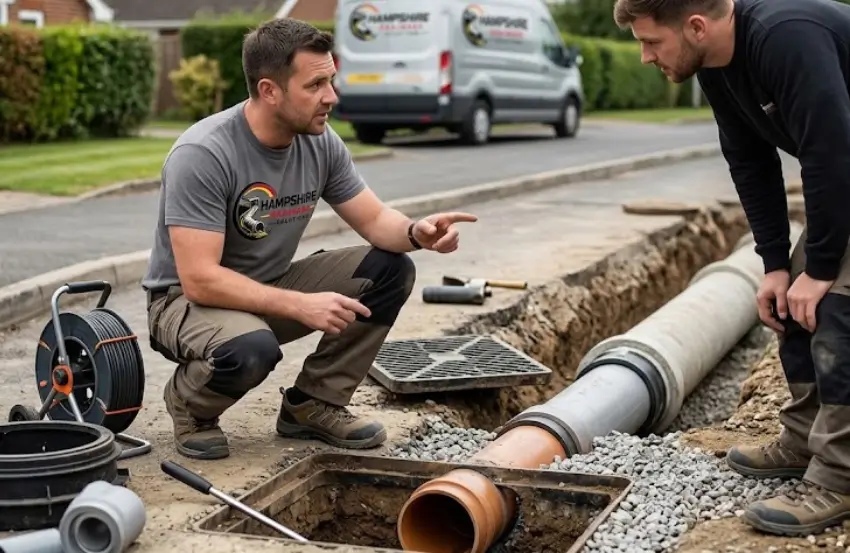
What Is a Lateral Drain in the Hampshire?
A lateral drain is a pipe that carries wastewater from a property’s drain towards a sewer, generally outside the property’s boundary.
It forms the connection between the private drainage system and the wider sewer network.
For example, wastewater may leave a house through a private underground drain, cross the property boundary through a lateral drain and eventually enter a public sewer beneath the road.
The lateral drain therefore plays an important role in transporting wastewater away from the property.
Is a Lateral Drain Private or Public?
Most lateral drains connected to the public sewer network in England are the responsibility of the sewerage company, following the 2011 transfer of many formerly private drains and sewers.
However, exceptions exist.
Lateral drains associated with certain private drainage systems, unadopted infrastructure or excluded arrangements may remain privately maintained.
The precise responsibility should be confirmed before arranging repairs.
Can a Lateral Drain Become Blocked?
Yes. Lateral drains can experience many of the same problems as other underground drainage pipes.
Common causes include grease accumulation, unsuitable items flushed into the drainage system, displaced joints, tree root intrusion and structural deterioration.
A blocked lateral drain may cause wastewater to drain slowly or back up towards the property.
Because lateral drains are often underground and outside the property boundary, locating the problem can require specialist inspection equipment.
Where the affected lateral drain is public, the sewerage company should normally be contacted before commissioning private repair work.
Who Is Responsible for Drains, Sewers and Lateral Drains in Hampshire?
Drainage responsibility depends on the type of pipe, the properties it serves and its legal status.
For most residential properties connected to the public sewer network in England, the general arrangements are straightforward.
Private drains within the property boundary are usually maintained by the property owner. Public sewers and adopted lateral drains are normally maintained by the relevant sewerage company.
Nevertheless, unusual drainage layouts can create uncertainty.
Does the Property Boundary Determine Drain Ownership?
The property boundary is important, but it is not the only factor.
A pipe within a garden may be a private drain, a shared public sewer or another type of drainage connection.
Similarly, a pipe outside the boundary is not necessarily publicly maintained.
The number of properties served, the pipe’s location and whether it has been adopted all influence responsibility.
A drainage survey can provide useful information about pipe routes and connections. For an explanation of maintenance responsibilities, see Southern Water’s guide to drains, sewers and lateral drains. Confirm ownership with the sewerage company serving your property before arranging repairs.
What Happens With Shared Drains?
Shared drainage arrangements are common in terraced houses, semi-detached properties and some developments with interconnected drainage systems.
Where a pipe carries wastewater from more than one property, it may legally be a sewer rather than a single-property drain.
Many shared sewers connected to the public network are now maintained by sewerage companies.
However, ownership should be verified, especially where the system is private or has not been adopted.
Property owners should not assume they must share repair costs simply because the pipe passes beneath their land.
For further information, see our guide to drainage services in Hampshire and consider arranging a professional inspection where the pipe’s condition is uncertain.
For an illustrated explanation of private and shared drainage responsibilities, see Thames Water’s guide to sewer pipe responsibility. Confirm the arrangements with the sewerage company serving your property.
How Can You Identify Which Drainage Pipe Is Blocked?
The location of a blockage is not always obvious from the symptoms alone.
A slow-draining sink may indicate a local waste-pipe obstruction, while several affected fixtures could suggest a problem further along the drainage system.
Repeated wastewater backups, overflowing inspection chambers and persistent unpleasant smells can indicate more extensive drainage problems.
Signs of a Blocked Private Drain
A private drain blockage may affect a single property’s wastewater system.
Water might drain slowly from multiple fixtures, toilets may make gurgling sounds, or wastewater may appear around an external inspection chamber.
These symptoms can also occur with blockages in public infrastructure, so they are not definitive evidence of ownership.
Signs of a Blocked Public Sewer or Lateral Drain
Problems affecting several neighbouring properties may indicate a shared sewer blockage.
Wastewater backing up from external drains or inspection chambers can also suggest an obstruction further downstream.
However, a lateral drain blockage can affect only one property, even when the pipe is publicly maintained.
The symptoms therefore need to be considered alongside the pipe layout.
Why Is a CCTV Drain Survey Useful?
A CCTV drain survey allows drainage specialists to inspect accessible underground pipework using a camera system.
It can help locate blockages, identify cracks, examine joints and assess potential root intrusion.
The inspection may also help establish where a drainage defect occurs in relation to inspection chambers and property boundaries.
This information is useful when deciding whether private repairs are needed or the issue should be referred to the sewerage company.
Importantly, a CCTV survey provides technical evidence about the pipe’s condition rather than a legal determination of ownership.
What Causes Drain, Sewer and Lateral Drain Problems?
Different sections of the drainage network can suffer similar faults.
The underlying cause may involve inappropriate waste disposal, deterioration of underground pipework or changes affecting the surrounding ground.
Grease and Food Waste
Cooking fats and oils can cool and accumulate inside drainage pipes.
Over time, these deposits may trap other materials and restrict wastewater flow.
Kitchen drainage problems can develop gradually before becoming a more significant obstruction.
Wet Wipes and Sanitary Products
Products that do not break down readily in water can become trapped inside pipes.
Wet wipes, sanitary products and other unsuitable items may combine with grease to form persistent blockages.
Only urine, faeces and toilet paper should normally be flushed down toilets.
Tree Root Intrusion
Tree roots can enter drainage pipes through existing cracks, defective joints or damaged connections.
Once inside, roots may grow and restrict wastewater flow.
Root intrusion can also contribute to recurring blockages and further pipe deterioration.
Damaged or Displaced Pipes
Underground pipes can become cracked, fractured or misaligned.
Ground movement, ageing materials, external loads and installation defects may contribute to structural problems.
Damaged pipes can trap waste, allow wastewater to escape or permit surrounding material to enter the drainage system.
Professional inspection is particularly useful where blockages repeatedly return after clearance.
How Can Homeowners Prevent Drainage Problems?
Preventing drainage problems begins with understanding how everyday activities affect wastewater pipes.
Small changes in household habits can reduce the amount of grease, food waste and unsuitable materials entering the drainage system.
Keep Cooking Fats Out of Sinks
Cooking oils and fats should be allowed to cool and disposed of appropriately rather than poured into kitchen sinks.
Wiping greasy cookware before washing can also reduce the amount of fat entering the pipes.
Dispose of Bathroom Waste Properly
Wet wipes, cotton buds, sanitary products and similar items belong in the bin rather than the toilet.
Even products marketed as flushable can create problems in some drainage systems.
Pay Attention to Recurring Symptoms
Repeated slow drainage, unpleasant smells and unusual gurgling noises should not be ignored.
A recurring problem may indicate a deeper obstruction or damaged underground pipe rather than a simple surface blockage.
Early investigation can help identify the cause before further disruption occurs.
Avoid Unsafe Drain-Clearing Methods
Strong chemical drain cleaners can create hazards for occupants and drainage workers, particularly when different products are mixed.
Do not enter inspection chambers or confined drainage spaces.
Where sewage is backing up, avoid contact with contaminated water, keep children and pets away and seek appropriate professional assistance.
When Should You Contact a Drainage Specialist?
Professional drainage assistance is appropriate when blockages keep returning, wastewater backs up, several fixtures are affected or underground pipe damage is suspected.
The first step is to consider whether the problem may involve a private drain or publicly maintained infrastructure.
Where a public sewer or adopted lateral drain appears to be affected, contacting the relevant sewerage company is usually the correct starting point.
For private drainage problems, a drainage specialist can investigate the cause and recommend suitable work.
Blocked Drain Clearance
Drain clearance is intended to remove obstructions and restore wastewater flow.
The appropriate method depends on the pipe’s condition, accessibility and the type of blockage.
CCTV Drain Surveys
A CCTV inspection can help identify hidden problems such as cracked pipes, displaced joints or recurring obstructions.
It may also help clarify the drainage layout before further work is considered.
Drain Repairs and Relining
Where a private drain is structurally damaged, repair options depend on the nature and extent of the defect.
Some pipes may be suitable for localised repairs or relining, while others require excavation or replacement.
A proper assessment should take place before selecting a repair method.
Why Do Drainage Responsibilities Matter for Hampshire Properties?
Hampshire includes a wide range of residential and commercial properties, from older housing to modern developments.
Different building layouts and drainage connections can affect how wastewater moves from individual properties into the public network.
For homeowners in Southampton, Portsmouth, Winchester, Basingstoke and surrounding areas, understanding pipe ownership can make it easier to report problems to the correct organisation.
It can also help landlords and property managers avoid commissioning unnecessary work on publicly maintained infrastructure.
The relevant sewerage company depends on the property’s location and drainage connection. The company providing drinking water may not be the organisation responsible for wastewater services.
Before arranging underground repair work, confirm which organisation maintains the affected pipe.
Frequently Asked Questions
1. What is the main difference between a drain and a sewer?
A drain normally carries wastewater from one property, while a sewer carries wastewater from more than one property. This distinction helps determine maintenance responsibility, although ownership also depends on whether the pipe is public or private.
2. Who is responsible for a lateral drain in England?
Most lateral drains connected to public sewers are maintained by the relevant sewerage company. However, some private or unadopted drainage arrangements are exceptions, so responsibility should be confirmed before repairs.
3. Is a drain outside my property boundary always public?
No. A pipe’s location alone does not establish ownership. Its function, connections and adoption status must also be considered. The sewerage company can help confirm whether the pipe forms part of its public network.
4. Can a CCTV drain survey identify a blocked lateral drain?
A CCTV drain survey can help locate blockages and structural defects in accessible pipework. It may also reveal connections and pipe routes, but it cannot independently establish legal ownership or maintenance responsibility.
5. Who should I contact about a blocked sewer in Hampshire?
Contact the sewerage company responsible for the property’s public wastewater network. For a suspected private drain blockage, contact a drainage specialist. Where ownership is unclear, ask the sewerage company to check its records.
Conclusion: Understanding Drain, Sewer and Lateral Drain Differences
Knowing the drain sewer and lateral drain differences helps property owners understand how wastewater leaves their premises and who may be responsible when problems occur. Private drains generally serve one property, sewers carry wastewater from multiple properties, and lateral drains connect individual drainage systems to the wider network.
Although these distinctions provide a useful starting point, responsibility can vary according to the pipe’s legal status and connections. For Hampshire property owners, confirming ownership before arranging repairs can help avoid unnecessary expense and ensure problems reach the correct organisation.