
Heavy rainfall can leave gardens waterlogged, create puddles around patios and send large volumes of surface water towards conventional drains. A rain garden offers a natural way to manage some of that excess water while creating an attractive planted area.
Rain garden drainage uses a shallow, planted depression to collect rainwater runoff from roofs, driveways, paths and other suitable surfaces. Rather than allowing water to flow immediately into underground drainage pipes, the garden temporarily holds it, filters it through soil and allows it to soak into the ground where conditions permit. Some designs also include an overflow or underdrain to manage water that cannot infiltrate.
At Hampshire Drain Expert, we recognise the importance of understanding how surface water moves around residential and commercial properties. Rain gardens can form part of a wider sustainable drainage approach, but their suitability depends on soil conditions, available space, groundwater levels and the existing drainage layout.
For property owners across Hampshire, understanding how rain gardens manage runoff can help when considering ways to reduce standing water and improve rainwater management. However, they are not a universal solution for flooding, blocked drains or damaged underground pipework.
What Is a Rain Garden Drainage System?
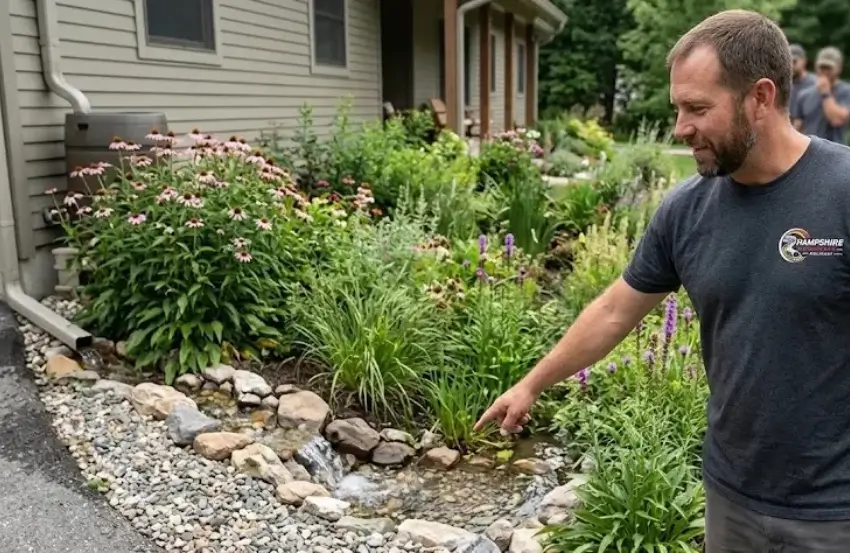
A rain garden is a specially designed landscaped area that collects and manages rainwater from nearby surfaces. Unlike an ordinary flower bed, it is positioned and shaped to receive runoff and temporarily store water during rainfall.
A typical rain garden drainage system combines plants, suitable soil, a shallow basin and a controlled route for water to enter and leave.
Rain gardens are an example of Sustainable Drainage Systems (SuDS). These systems aim to manage surface water in ways that reflect natural processes rather than relying entirely on underground pipes.
The GOV.UK national standards for sustainable drainage systems explain how SuDS can support runoff management, water quality and biodiversity.
What Makes a Rain Garden Different From an Ordinary Garden?
An ordinary flower bed is generally designed for growing plants. A rain garden has an additional drainage function.
Its key features may include:
- A shallow depression where rainwater temporarily collects.
- A designed inlet from a roof, path or other suitable surface.
- Soil capable of supporting plants and allowing appropriate water movement.
- Vegetation that tolerates alternating wet and dry conditions.
- An overflow route for rainfall exceeding the garden’s capacity.
- An underdrain or engineered soil layers where required by the design.
A properly functioning rain garden should not normally remain permanently flooded. It is intended to hold water temporarily before draining, evaporating or releasing it through an approved outlet.
How Do Rain Gardens Manage Stormwater Runoff?
Understanding how rain gardens manage stormwater begins with the movement of rainwater across a property.
During rainfall, hard surfaces such as roofs and paved areas prevent much of the water from soaking directly into the ground. Instead, it flows towards gutters, gullies, drains or lower sections of the landscape.
A rain garden intercepts some of this water and manages it through several connected processes.
1. Collecting Rainwater From Surrounding Surfaces
Rainwater enters the garden through a suitable inlet.
Possible sources include roof downpipes, garden paths and appropriately designed drainage channels.
The inlet should distribute water without washing away soil or damaging plants. Stones or other erosion-control materials may be used where water enters the basin.
Only suitable runoff should be directed into a rain garden. Water contaminated with sewage, chemicals or other harmful substances requires different treatment and must not simply be diverted into the soil.
2. Temporarily Holding Surface Water
The shallow depression provides temporary storage during rainfall.
This reduces the speed at which some runoff leaves the contributing surface. The amount stored depends on the garden’s dimensions, soil conditions and design.
Rain gardens are not intended to contain unlimited quantities of water. During heavier storms, water may reach the overflow level.
3. Filtering Water Through Soil and Vegetation
As water passes through suitable soil, sediment and some pollutants can be retained or processed through physical, chemical and biological processes.
Plants also support soil structure and take up some water.
The effectiveness of filtration varies with the soil, vegetation, runoff quality and maintenance. A rain garden should not be treated as a system that makes contaminated water safe.
4. Allowing Water to Infiltrate
Where ground conditions are suitable, collected rainwater gradually infiltrates into the surrounding soil.
Infiltration can reduce the amount of runoff entering conventional drainage systems.
However, heavy clay, compacted ground, shallow groundwater or contaminated land may make infiltration unsuitable.
5. Managing Excess Water Through an Overflow
A correctly designed overflow provides a safe route for water when the garden reaches its storage capacity.
Depending on the site, excess water may be directed towards another suitable SuDS feature or an authorised drainage outlet.
Overflow water must not be allowed to damage buildings, flood neighbouring properties or enter an inappropriate sewer connection.
What Are the Main Components of a Rain Garden?
The construction of a rain garden depends on the property, available space and drainage objectives.
| Component | Main Function | Important Consideration |
|---|---|---|
| Inlet or channel | Directs runoff into the garden | Must limit erosion and blockages |
| Shallow planted basin | Temporarily stores rainwater | Requires suitable depth and capacity |
| Soil or engineered growing medium | Supports plants and water movement | Must suit the drainage design |
| Vegetation | Supports water uptake and soil health | Must tolerate wet and dry periods |
| Mulch or surface protection | Helps protect exposed soil | Must not obstruct water movement |
| Overflow outlet | Manages excess rainfall | Requires a safe discharge destination |
| Underdrain, where needed | Collects water that cannot infiltrate adequately | Requires appropriate design and an authorised outlet |
Not every rain garden requires an underdrain, engineered filter layers or a connection to a conventional drainage system.
Simple domestic rain gardens may rely on suitable existing soil. More complex installations may require specialist drainage design.
What Are the Benefits of Rain Garden Drainage?
Rain gardens can offer several advantages when they are correctly designed and maintained.
Reducing Surface Water Runoff
By temporarily storing rainfall and allowing some of it to infiltrate, rain gardens can reduce runoff volumes from the surfaces they serve.
This may help manage water around gardens, patios and landscaped areas.
The benefit depends on rainfall intensity, ground conditions and the size of the garden.
Supporting Sustainable Drainage
Rain gardens can complement other surface water drainage solutions, including permeable paving, swales, rainwater harvesting and appropriately designed soakaways.
Using several measures together may be more effective than relying on one feature.
Improving Water Quality
Soil and vegetation can help capture sediment and reduce certain pollutants carried by runoff.
Regular maintenance is important because accumulated sediment can eventually reduce infiltration performance.
Creating Habitat for Wildlife
Suitable planting can provide food and shelter for insects and other wildlife.
A varied planting scheme may also improve the appearance of outdoor spaces throughout the year.
Reducing Pressure on Conventional Drainage
Where a rain garden captures water that would otherwise enter a drainage network, it can reduce the volume or rate of runoff reaching that network during some rainfall events.
However, it cannot repair broken pipes, clear blocked gullies or resolve every cause of drainage flooding.
Where Should a Rain Garden Be Installed?
Location is one of the most important considerations in rain garden installation and maintenance.
A suitable position should allow rainwater to enter naturally or through a carefully designed channel while protecting nearby structures.
Check the Distance From Buildings
Water must not be deliberately concentrated beside foundations without appropriate assessment.
The Royal Horticultural Society’s rain garden guidance recommends seeking specialist geotechnical advice when proposing a rain garden closer than five metres to a house.
This is a useful precaution, not a universal rule that makes every location beyond five metres automatically safe.
Assess Soil Permeability
Before installing an infiltration-based rain garden, the ground needs to be assessed.
Sandy or freely draining soil may allow water to infiltrate relatively easily, while compacted clay may retain water for longer.
A simple garden drainage observation can help identify potential problems, but formal infiltration testing may be necessary to design a reliable system.
Consider Underground Services
Drainage pipes, electricity cables, gas services and other buried infrastructure may pass through the proposed installation area.
Their location should be established before excavation.
Plan a Safe Overflow Route
The garden needs a route for excess water during heavy rainfall.
This is particularly important on sloping sites, beside buildings or near neighbouring boundaries.
The overflow must not create a new flooding problem elsewhere.
Can Rain Gardens Work in Clay Soil?
Rain gardens can sometimes be designed for clay-rich ground, but the drainage arrangement may need to differ from a simple infiltration garden.
Clay soils often allow water to pass through more slowly than freely draining soils.
This means water may remain in the planted basin for longer, particularly during wet winter conditions.
Possible approaches include:
- Assessing whether the existing soil can provide sufficient infiltration.
- Using a suitable engineered growing medium where justified.
- Providing temporary storage with a designed outlet.
- Considering an underdrain where an appropriate discharge route exists.
- Selecting plants suited to the expected moisture conditions.
- Choosing a different drainage solution where infiltration is unsuitable.
Adding gravel to a hole does not automatically solve poor drainage. Without a suitable route for water to leave, the excavation may simply fill and remain wet.
A drainage assessment is particularly important where persistent standing water already affects the property.
How Are Rain Gardens Designed and Installed?
Rain garden installation should begin with an understanding of the site rather than excavation.
The process varies between a small domestic landscape feature and a larger engineered SuDS installation.
Step 1: Identify the Runoff Source
Determine which surfaces contribute rainwater to the proposed garden.
A roof downpipe, for example, may serve a defined section of the roof rather than the entire building.
The contributing area affects how much water the rain garden may need to accommodate.
Step 2: Examine Ground Conditions
Review soil permeability, slope, groundwater conditions, nearby structures and existing drainage.
Contaminated ground, unstable slopes and high groundwater levels may require specialist investigation or an alternative approach.
Step 3: Calculate the Required Capacity
The rain garden must be sized for the runoff it is intended to manage.
Relevant factors include:
- Area of roof or paving draining towards the garden.
- Expected rainfall and design storm requirements.
- Soil infiltration performance.
- Available temporary storage depth.
- Suitable overflow arrangements.
- Space available for planting and maintenance.
A generic garden-size formula should not replace a site-specific drainage calculation where flooding consequences are significant.
Step 4: Design the Inlet and Overflow
Water should enter without excessive erosion.
The overflow must direct excess rainfall towards a safe and suitable destination.
Any proposed connection to a public sewer or other controlled drainage system may require permission from the relevant owner or authority.
Step 5: Prepare the Basin and Soil
Excavation should follow the approved design while protecting buried services and nearby structures.
Compaction should be minimised because compacted soil can restrict infiltration.
The growing medium should support both drainage performance and plant establishment.
Step 6: Select Suitable Plants
Choose plants according to the expected wet and dry conditions, soil characteristics, light levels and maintenance requirements.
Plants near the lowest part of the basin may experience more frequent saturation than those near the edges.
Step 7: Test and Monitor the Installation
Once installed, observe how water enters, collects and leaves the garden.
Check for erosion, blocked inlets, unexpected overflow and prolonged standing water.
Monitoring during several rainfall events can reveal problems that are not apparent immediately after construction.
Which Plants Are Suitable for a UK Rain Garden?
Plant selection should reflect the moisture conditions within the garden.
Some species tolerate occasional waterlogging, while others prefer the drier edges.
Possible plants to consider include:
- Purple loosestrife: Suitable for moist planting areas where growing conditions allow.
- Yellow flag iris: A moisture-tolerant plant that requires adequate space and appropriate management.
- Meadowsweet: Often suited to damp soils and naturalistic planting.
- Tufted hair grass: A grass that can tolerate a range of moisture conditions.
- Certain sedges: Useful in suitable wet or intermittently damp planting areas.
Plant suitability varies by species and cultivar. Local ecological considerations, mature size and maintenance needs should guide the final selection.
Avoid allowing aggressive plants to dominate the garden or obstruct its drainage function.
How Should a Rain Garden Be Maintained?
Regular maintenance helps keep the garden attractive and ensures water can move through it as intended.
Rain garden maintenance is generally focused on vegetation, sediment, inlets, outlets and soil condition.
| Maintenance Task | Suggested Inspection Period | Purpose |
|---|---|---|
| Check inlet and overflow | After significant rainfall | Identify debris and obstruction |
| Remove litter and loose debris | Regularly | Maintain water flow |
| Inspect planting | During the growing season | Replace failed plants and control weeds |
| Check for erosion | After heavy storms | Protect soil and planting |
| Monitor standing water | Following rainfall | Identify drainage deterioration |
| Review sediment accumulation | Periodically | Reduce the risk of clogging |
| Inspect underdrains, where present | According to the maintenance plan | Confirm the outlet remains functional |
These are general maintenance suggestions. An engineered SuDS installation should follow its site-specific management and maintenance plan.
Warning Signs That a Rain Garden Is Not Working Properly
Common warning signs include:
- Water remaining for unusually long periods after rainfall.
- Sediment repeatedly building up near the inlet.
- Water bypassing the garden rather than entering it.
- Overflow reaching buildings or neighbouring land.
- Soil erosion around the inlet.
- Plants dying because of persistent saturation.
- An underdrain or outlet becoming obstructed.
Persistent problems may indicate that the garden is undersized, the soil is unsuitable or an inlet or outlet requires attention.
Can a Rain Garden Prevent Flooding?
A rain garden can help reduce certain types of surface water runoff, but it cannot guarantee flood prevention.
Its effectiveness depends on the rainfall event, the area draining into it, available storage and the rate at which water can leave.
During prolonged or intense storms, even a correctly designed rain garden may reach capacity.
Flooding can also arise from causes that rain gardens cannot address, including blocked underground pipes, sewer surcharge, groundwater flooding and water entering from neighbouring land.
For this reason, rain gardens should be considered one potential part of a broader drainage strategy.
Rain Garden Drainage vs Traditional Drainage Systems
Rain gardens and conventional drainage systems perform related but different functions.
| Feature | Rain Garden | Conventional Drainage |
|---|---|---|
| Main purpose | Manage runoff through temporary storage, planting and infiltration or controlled discharge | Convey water through pipes and drainage channels |
| Water treatment | Soil and vegetation may improve runoff quality | Depends on the wider system |
| Visual appearance | Landscaped planted feature | Usually mostly underground |
| Space requirements | Requires suitable landscaped area | Requires space for pipes, chambers and outlets |
| Maintenance | Plant care, sediment removal and inlet inspections | Pipe, gully and chamber inspections and clearance |
| Main limitation | Depends on soil, capacity and safe overflow | Depends on pipe condition, capacity and outlet performance |
The two approaches can work together.
For example, a property may use a rain garden to manage part of its roof runoff while retaining conventional drainage for other surfaces.
To understand how rainwater drainage differs from wastewater drainage, read our guide to the difference between surface water and foul water drains.
Are Rain Gardens Suitable for Properties in Hampshire?
Rain gardens may be worth considering for some residential and commercial properties across Hampshire, including suitable sites in Southampton, Portsmouth, Winchester and Basingstoke.
However, the county contains varied ground conditions and development types. It would be misleading to assume that a particular town has uniformly suitable soil or groundwater conditions.
A property with an established garden may have different opportunities from a terraced property with limited outdoor space or a commercial site dominated by hardstanding.
For Hampshire property owners, the main questions are whether suitable runoff can be collected, whether the ground can manage it and where excess water will go.
What About Existing Drainage Problems?
A rain garden is not a substitute for investigating a blocked or damaged drainage system.
For example, repeated flooding around an outside gully may be caused by a pipe obstruction rather than simply excessive rainfall.
Where drainage faults are suspected, a professional inspection may help identify the underlying issue before landscape changes are made.
Hampshire Drain Expert provides drain clearance services for drainage problems requiring professional attention.
Where the condition of underground pipework is uncertain, a CCTV drain survey may help identify defects or obstructions.
For existing pipe damage, explore our drain repair and relining services.
When Should You Seek Professional Drainage Advice?
Professional advice is appropriate when a rain garden could affect foundations, neighbouring properties, buried services or existing drainage connections.
A drainage specialist or suitably qualified drainage designer may also be needed when:
- Surface water repeatedly floods the same area.
- Soil remains saturated for extended periods.
- A proposed rain garden is close to a building.
- The site has limited space for overflow.
- Groundwater conditions are uncertain.
- The installation involves substantial roof or paved catchments.
- An existing underground drainage problem is suspected.
- A commercial or development project requires a formal SuDS design.
Where water is already entering a building or sewage is backing up, address the immediate drainage problem rather than relying on a landscaping change.
Frequently Asked Questions About Rain Garden Drainage
1. How does a rain garden drainage system work?
A rain garden collects surface water in a shallow planted basin, temporarily stores it and allows water to infiltrate through suitable soil. Some designs use an overflow or underdrain to manage excess rainfall.
2. Can a rain garden stop a garden from flooding?
A properly designed rain garden can reduce some surface water runoff and localised ponding. However, it cannot guarantee protection against severe storms, groundwater flooding or blocked underground drainage.
3. Do rain gardens work during heavy rainfall?
Rain gardens can manage rainfall up to their design capacity. During heavier storms, excess water should follow a safe overflow route. Their performance depends on sizing, soil conditions and maintenance.
4. How often should a rain garden be maintained?
Inlets and overflow routes should be checked regularly and after significant rainfall. Plants, sediment and soil condition also need periodic attention. Engineered installations should follow their maintenance plans.
5. Is a rain garden better than a soakaway?
Neither is automatically better. A rain garden provides planted surface storage and potential water-quality benefits, while a soakaway generally provides underground infiltration storage. The appropriate choice depends on soil conditions, available space, runoff volume and site constraints.
Conclusion: Is a Rain Garden the Right Drainage Solution?
Rain gardens offer a practical way to manage suitable surface water runoff while improving the appearance and ecological value of outdoor spaces.
By collecting, temporarily storing and filtering rainwater, they can reduce the amount of runoff reaching conventional drainage systems. Their effectiveness, however, depends on careful design, suitable ground conditions and ongoing maintenance.
For Hampshire homeowners, landlords and commercial property managers, a rain garden may complement an existing drainage arrangement, but it should not be used to conceal or bypass unresolved drainage defects.
Concerned about standing water, blocked drains or recurring drainage problems?
Contact Hampshire Drain Expert to discuss your drainage concerns and arrange an appropriate assessment.
Call: 07534247438
Website: Hampshire Drain Expert
Get Help With a Blocked Drain | Request a Drainage Assessment