
Rainwater falling onto your roof, driveway or garden needs somewhere to go. Gutters, downpipes and underground drainage systems help move this water away from buildings, reducing the risk of standing water, damp conditions and localised flooding. However, not every property uses the same method to manage rainfall.
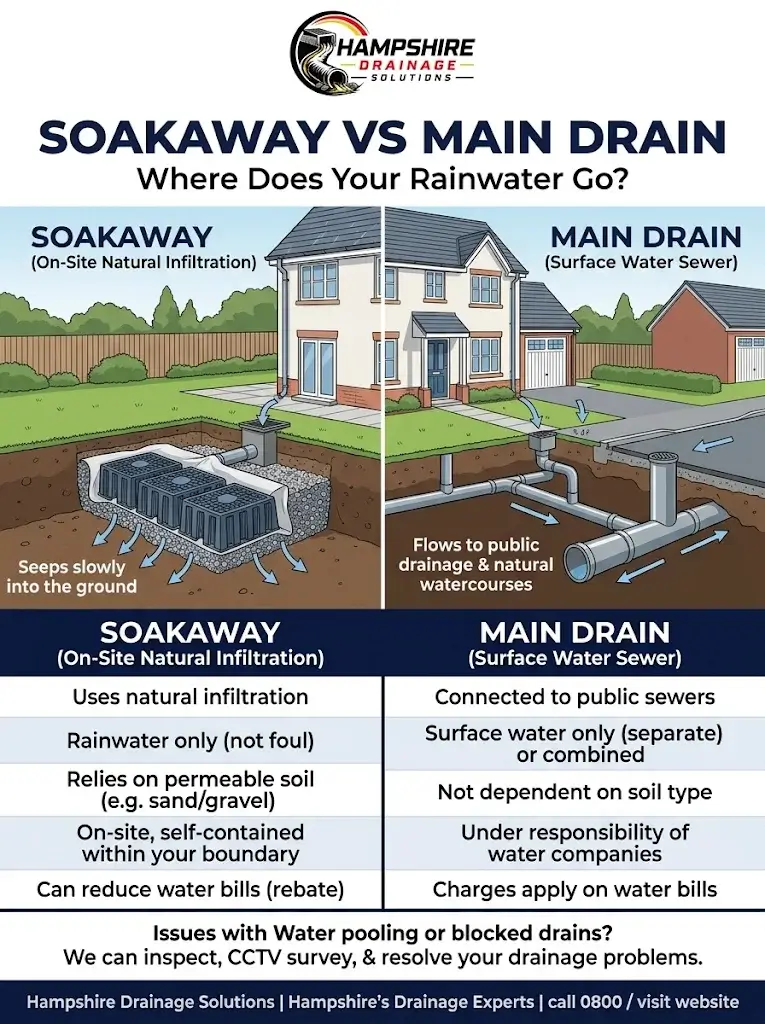
The soakaway vs main drain question comes down to where the collected water ultimately goes. A soakaway allows rainwater to infiltrate the surrounding ground, while a connection to a main drainage network carries it through underground pipes towards an authorised discharge point or treatment system.
In the UK, some properties discharge rainwater into dedicated surface water sewers. Others use soakaways, while older drainage arrangements may include combined sewers carrying both surface water and wastewater.
Understanding the difference between soakaway and main drain systems helps homeowners recognise drainage problems, plan property improvements and investigate unexpected flooding.
At Hampshire Drain Expert, we provide drainage services across Hampshire, including CCTV drain surveys and drain clearance. Understanding the route of your property’s rainwater drainage is an important starting point when investigating recurring blockages, overflowing drains or unexplained standing water.
What Is the Difference Between a Soakaway and a Main Drain?
A soakaway and a main drain perform different functions, although both can form part of a property’s rainwater drainage arrangements.
A soakaway is an underground infiltration system designed to temporarily hold rainwater and allow it to disperse into suitable surrounding soil.
A main drain, in everyday language, usually refers to a larger drainage pipe or sewer carrying water away from a property. The term can be misleading because the receiving network may be a surface water sewer, a foul sewer or a combined sewer.
For rainwater drainage, the important distinction is not simply whether water enters a pipe. It is where that pipe leads and whether the connection is appropriate.
Soakaway vs Main Drain Comparison
| Feature | Soakaway | Main Drain or Sewer Connection |
|---|---|---|
| Main purpose | Allows rainwater to infiltrate the ground | Transports water through a drainage network |
| Water destination | Surrounding soil | An authorised outfall, sewer network or treatment system |
| Typical water source | Roofs and suitable surface runoff | Surface water, foul water or both, depending on the system |
| Main components | Infiltration structure, surrounding soil and connecting pipes | Underground pipes, junctions and inspection chambers |
| Main limitations | Soil permeability, groundwater levels and available space | Network capacity, pipe condition and connection arrangements |
| Possible problems | Poor infiltration, sediment accumulation or saturation | Blockages, damaged pipes, surcharging or incorrect connections |
| How to investigate | Drainage records, tracing and suitable site investigation | Drainage records, inspection chambers, tracing and CCTV surveys |
Neither system is automatically better for every existing property. Suitability depends on the site, ground conditions, drainage design and applicable regulations.
How Does a Soakaway Drainage System Work?
A soakaway collects rainwater and allows it to infiltrate gradually into the surrounding ground.
Rainwater typically enters the system through roof gutters, downpipes or suitable surface drainage channels. Underground pipes carry the water to an infiltration structure.
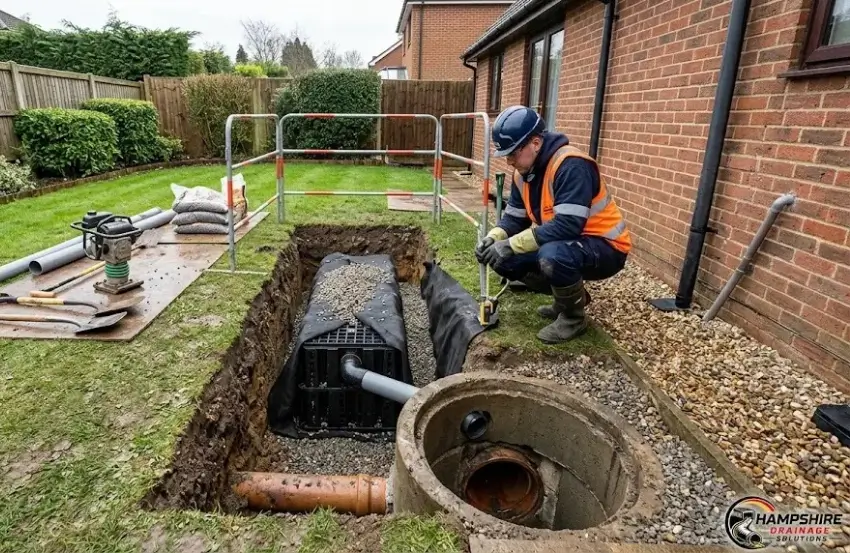
Traditional soakaways may contain clean stone or other suitable granular material. Modern systems can use purpose-designed modular storage units.
The structure provides temporary storage while the surrounding soil absorbs the collected water.
What Happens During Heavy Rainfall?
During rainfall, water enters the soakaway and begins infiltrating into the soil.
When rain falls faster than the ground can absorb it, water temporarily accumulates within the available storage space.
A correctly designed system should have sufficient storage and infiltration capacity for its intended conditions.
However, prolonged rainfall, saturated ground or unsuitable soil can reduce performance.
What Ground Conditions Affect Soakaways?
Several factors influence soakaway suitability:
- Soil permeability: Freely draining soil generally allows faster infiltration than heavy clay.
- Groundwater levels: High groundwater can restrict available infiltration capacity.
- Available space: The soakaway needs an appropriate location and separation from structures.
- Ground stability: Excavations and infiltration must not compromise nearby foundations.
- Sediment: Soil particles and debris can gradually reduce infiltration performance.
- Drainage design: The system must accommodate expected runoff and relevant site conditions.
A soakaway should not be installed solely because there is space in a garden. Site suitability and relevant drainage requirements need to be assessed first.
For further guidance, see the GOV.UK guidance on rainwater drainage for new building work.
How Does Rainwater Enter a Main Drain or Sewer?
Rainwater connected to a drainage network normally travels through underground pipes after entering gutters, gullies or surface water drainage channels.
The destination depends on the type of sewer serving the property.
Separate Surface Water Sewer
A surface water sewer is designed to carry rainwater runoff rather than household wastewater.
Rainwater from roofs, roads and other drained surfaces may enter this network through authorised connections.
The water may eventually discharge into a watercourse or another approved drainage arrangement, depending on the network.
Combined Sewer
A combined sewer carries both wastewater and rainwater in the same pipe network.
Combined systems are more common in some older developed areas.
During heavy rainfall, additional surface water can place pressure on these networks. That does not mean every property connected to a combined sewer will experience flooding.
Foul Water Sewer
A foul water sewer is intended to carry wastewater from toilets, sinks, baths and other household fixtures.
Rainwater should not be connected to a separate foul-only sewer without the appropriate legal and technical authorisation.
Incorrect connections can increase flows within the foul network and contribute to drainage problems.
Surface Water Drainage vs Foul Water Drainage: Why Does It Matter?
Understanding surface water drainage vs foul water drainage is essential when checking where water leaves a property.
Surface water drainage deals primarily with rainfall and runoff.
Foul water drainage carries wastewater generated by normal domestic or commercial activities.
These flows may be transported separately or together, depending on the drainage network.
| Surface Water Drainage | Foul Water Drainage |
|---|---|
| Roof rainwater | Toilet wastewater |
| Driveway runoff | Bath and shower wastewater |
| Patio runoff | Kitchen sink wastewater |
| Rainwater gullies | Washing machine wastewater |
| May use a soakaway or surface water sewer | Usually enters a foul or combined sewer where mains drainage is available |
An important exception is that some existing combined sewer systems legally carry both types of water.
Consequently, the presence of rainwater in a sewer does not automatically indicate an incorrect connection.
The property’s drainage layout and receiving sewer type must be established before reaching a conclusion.
How Can You Tell Where Your Rainwater Goes?
The most reliable approach is to combine available drainage records with a physical investigation.
A visible downpipe does not reveal the final destination of the rainwater.
It may discharge into a nearby gully, connect to underground pipework, enter a soakaway or feed an authorised sewer connection.
Step 1: Inspect Visible Gutters and Downpipes
Start by observing where roof gutters discharge.
Check whether downpipes lead into:
- A visible surface water gully
- Underground drainage pipework
- A rainwater collection system
- A drainage channel
- A visible surface discharge arrangement
Look for disconnected joints, overflowing gullies and signs of persistent water accumulation.
Do not assume a downpipe entering the ground connects directly to a public sewer.
Step 2: Review Drainage Plans and Property Documents
Building plans, drainage drawings and relevant property records may show the intended drainage arrangement.
Useful sources can include building control documents, previous drainage surveys and information supplied during a property purchase.
Water company sewer records may help identify public sewers, but they do not necessarily show every private drain, soakaway or connection.
Older properties may also have drainage alterations that are not reflected in available records.
Step 3: Look for Inspection Chambers
Inspection chambers provide access to sections of underground drainage pipework.
Their locations and the direction of connecting pipes may help a drainage specialist understand the layout.
However, an inspection chamber alone does not establish the final discharge point.
For safety, homeowners should not enter chambers, lift heavy covers without appropriate equipment or attempt to investigate confined drainage spaces.
Step 4: Arrange a CCTV Drain Survey
A professional CCTV drain survey can help examine accessible underground pipework.
Depending on the drainage arrangement, pipe condition and available access, an inspection may identify:
- Pipe direction and connections
- Sediment or debris accumulation
- Root intrusion
- Structural damage
- Potential restrictions
- Sections requiring further investigation
A CCTV survey cannot always confirm the final destination of a drainage system. Some soakaways, buried junctions or inaccessible connections may require additional tracing or investigation.
Hampshire Drain Expert offers CCTV drain surveys in Hampshire for investigating suitable underground drainage systems.
What Are the Warning Signs of a Blocked or Failing Soakaway?
Soakaway problems can become more noticeable during periods of prolonged or heavy rainfall.
Common warning signs include:
- Persistent standing water: Rainwater remains near gullies, downpipes or drainage areas long after rainfall.
- Repeated overflowing gullies: Water backs up around the inlet instead of draining normally.
- Waterlogged ground: A particular area remains unusually wet compared with the surrounding garden.
- Recurring drainage problems: Rainwater drainage appears to improve temporarily before becoming restricted again.
- Unexpected damp conditions: Moisture develops near external walls or other vulnerable areas.
These symptoms do not prove that a soakaway has failed.
A blocked connecting pipe, saturated soil, inadequate drainage capacity or another site drainage problem may produce similar symptoms.
Can a Soakaway Become Blocked?
Yes. Sediment, silt, debris and material entering the system can reduce its effectiveness.
Some problems involve the pipe feeding the soakaway rather than the infiltration structure itself.
In other cases, the surrounding ground may simply be unable to absorb water at the required rate.
Identifying the cause matters because clearing an upstream pipe will not necessarily restore an infiltration system affected by unsuitable ground conditions.
What Problems Can Affect Main Drain Connections?
A rainwater pipe connected to a drainage network can experience many of the same issues as other underground drains.
Potential causes include:
- Silt and sediment accumulation
- Leaves and other debris entering gullies
- Root intrusion through damaged joints
- Displaced or fractured pipework
- Poor pipe gradients
- Restricted or damaged connections
- Sewer surcharging during heavy rainfall
Water backing up from a gully does not automatically mean the public main sewer is blocked.
The restriction could be within private drainage pipework, an inspection chamber or a connecting drain.
Where wastewater or sewage is also backing up, avoid contact with contaminated water and seek appropriate professional assistance.
For help with suspected drainage restrictions, see our drain clearance services in Hampshire.
Is a Soakaway Better Than Connecting Rainwater to the Main Drain?
There is no universal answer.
For new developments in England, sustainable rainwater management and infiltration options are important considerations within the applicable drainage hierarchy and building requirements.
However, infiltration is not suitable for every site.
A soakaway may be appropriate where soil conditions, groundwater levels, available space and drainage design support its use.
A sewer connection may be considered where permitted and where more preferable drainage options are unsuitable or unavailable.
When Might a Soakaway Be Suitable?
A soakaway may be considered when:
- Ground investigations demonstrate adequate infiltration.
- There is sufficient space for an appropriately designed system.
- Groundwater and contamination risks are acceptable.
- Required separation distances can be achieved.
- The system can be maintained appropriately.
When Might a Sewer Connection Be Necessary?
A sewer connection may be considered where infiltration is unsuitable and the proposed arrangement satisfies the relevant permissions and drainage requirements.
For example, restricted ground permeability or challenging site conditions may limit soakaway feasibility.
However, an available sewer does not automatically mean a new rainwater connection will be approved.
Before changing an existing drainage arrangement, consult the relevant water company, drainage designer or local authority as appropriate.
Who Is Responsible for Rainwater Drainage at a UK Property?
Responsibility depends on the location, ownership and legal status of the drainage assets.
Generally, homeowners are responsible for maintaining private drainage systems serving their property, including privately owned soakaways.
Public sewers and some transferred lateral drains are usually the responsibility of the relevant sewerage undertaker in England and Wales.
However, ownership boundaries and individual circumstances can vary.
What About Shared Drains?
Some drainage pipes serve more than one property.
Depending on their legal status and location, they may form part of the public sewerage network rather than remaining entirely private.
A drainage plan or professional investigation can help identify the pipe layout, while the relevant water company can clarify public sewer responsibilities.
For a more detailed explanation, read our guide to shared drain responsibility.
For independent regulatory information, visit Ofwat, the economic regulator for the water sector in England and Wales.
How Do Rainwater Drainage Problems Affect Hampshire Properties?
Properties across Hampshire can have different drainage arrangements depending on their age, location, ground conditions and previous building alterations.
Homes in Southampton, Portsmouth, Winchester, Basingstoke and surrounding areas should not be assumed to have identical rainwater drainage systems.
An older property may have a combined drainage arrangement, while another home may rely on a separate surface water connection or private soakaway.
Local soil conditions and drainage design also influence how effectively rainwater can be managed.
Why Is Property-Specific Investigation Important?
A drainage problem that appears similar at two properties may have entirely different causes.
For example, standing water near a downpipe could result from a blocked gully at one property and inadequate infiltration at another.
Similarly, recurring rainwater backups may indicate a damaged underground connection rather than a problem with the receiving sewer.
Hampshire Drain Expert provides drainage services across Hampshire, helping property owners investigate drainage issues and understand potential next steps.
Can You Change From a Main Drain Connection to a Soakaway?
In some circumstances, an existing rainwater drainage arrangement can be altered.
However, changing from a sewer connection to a soakaway requires more than disconnecting a downpipe and directing water into the garden.
A suitable assessment may need to consider:
- Existing drainage connections and ownership.
- Ground permeability and infiltration testing.
- Groundwater conditions and contamination risks.
- Distance from buildings and neighbouring property.
- Available space and expected rainwater runoff.
- Relevant building regulations and permissions.
- Maintenance access and long-term performance.
For new building work, the relevant guidance includes Approved Document H: Drainage and Waste Disposal.
Drainage changes should be designed and assessed by appropriately competent professionals rather than carried out through trial and error.
How Can You Prevent Rainwater Drainage Problems?
Regular maintenance can help prevent avoidable restrictions in accessible parts of a rainwater drainage system.
Keep Gutters and Gullies Clear
Remove accessible leaves and debris from gutters and surface drainage inlets using safe methods.
Blocked gutters can overflow against external walls, while obstructed gullies may cause localised ponding.
Avoid working at height without suitable equipment and competence.
Watch for Changes After Heavy Rainfall
Observe how quickly standing water clears after rainfall.
Occasional pooling during exceptionally heavy rain does not always indicate a defect, but persistent or recurring problems deserve investigation.
Avoid Sending Debris Into Drains
Do not wash soil, cement, paint, grease or building materials into surface drainage systems.
These substances can cause restrictions, contamination or damage.
Investigate Repeated Blockages
Repeated clearance without identifying the underlying cause may provide only temporary improvement.
A professional drainage assessment can help establish whether the issue involves pipework, connections, structural damage or infiltration performance.
Consider Drainage Maintenance
Properties with recurring drainage issues may benefit from planned inspection and appropriate maintenance.
The correct approach depends on the type of system and its condition.
Frequently Asked Questions
1. How Do I Know Whether My Rainwater Goes Into a Soakaway or Main Drain?
Check available drainage plans, visible downpipe connections and inspection chambers. A professional drainage investigation, potentially including CCTV inspection and pipe tracing, can help identify where accessible rainwater pipes lead. Some systems require further investigation to confirm the final discharge point.
2. Can Rainwater Go Into the Main Sewer in the UK?
Yes, where the connection is authorised and appropriate for the receiving sewer. Rainwater may enter a dedicated surface water sewer or an existing combined sewer. It should not be connected to a separate foul-only sewer without appropriate authorisation.
3. What Happens When a Soakaway Stops Working?
Rainwater may accumulate near gullies, downpipes or the soakaway area. Causes can include sediment accumulation, restricted connecting pipes, saturated ground or inadequate infiltration capacity. Investigation is needed before deciding whether clearance, repair or redesign is appropriate.
4. Can a CCTV Drain Survey Find a Soakaway?
A CCTV survey may trace accessible pipework towards a soakaway or reveal associated defects. However, it cannot always identify a buried infiltration structure or confirm its performance. Additional tracing, records or site investigations may be necessary.
5. Who Pays for a Blocked Rainwater Drain?
The responsible party depends on whether the affected asset is private, shared or part of the public sewerage network. Homeowners generally maintain private drainage systems, while the relevant sewerage undertaker usually maintains public sewers and certain lateral drains. Ownership should be confirmed before arranging work.
Conclusion: Understanding Where Your Rainwater Goes
The difference between a soakaway and a main drain is fundamentally about how rainwater leaves a property.
A soakaway manages suitable rainwater runoff through ground infiltration. A main drainage connection transports water through an underground pipe network, which may be designed for surface water, foul water or combined flows.
Neither arrangement should be judged solely by what is visible above ground.
Drainage plans, pipe tracing and suitable professional inspections can help establish the existing system and identify potential problems.
Need Help Investigating Your Rainwater Drainage in Hampshire?
Recurring standing water, overflowing gullies and unexplained drainage backups can indicate several different problems.
Hampshire Drain Expert provides drainage services, including CCTV drain surveys, drain clearance and drainage repairs, across Hampshire.
Contact our team to discuss the symptoms and arrange an appropriate next step.
Call: 07307508571
Website: Contact Hampshire Drain Expert