
We provide no dig drain repair for cracked pipe issues using trenchless methods that restore the pipe from within, without defaulting to open excavation.
If your drain has a crack, fracture, or a failing connection, we assess whether the defect can be repaired with a localised patch, CIPP lining, or another targeted rehabilitation method.
This service is designed for homeowners, landlords, managing agents, and commercial property teams who need a practical repair with less disruption to driveways, gardens, flooring, paved areas, and day to day site use.
Our role is to diagnose the defect properly, recommend the least disruptive option, and tell you clearly when no dig repair is suitable and when a fuller rehabilitation approach is the better choice.
No dig drain repair for cracked pipes with less disruption to your property
Cracked drains do not always need to be dug up. For many point defects, current UK trenchless guidance supports localised repair techniques that address the damaged section rather than carrying out full manhole-to-manhole rehabilitation, which can mean less time on site, less equipment, and a smaller working footprint around your property.
“Our no dig drain repair service targets point defects, so you are not pushed into full manhole-to-manhole rehabilitation when a localised repair will do the job.”
When the crack is confined to one area, a localised patch repair can often restore the pipe where it has failed. That is especially useful when the defect sits beneath hard landscaping, access routes, or occupied parts of a building where excavation would create avoidable mess and delay.
For longer damaged runs, we may recommend cured-in-place pipe lining, often called CIPP lining. This uses a resin-saturated lining tube installed inside the existing drain to create a close-fit pipe-within-a-pipe, helping seal the line and restore service without removing the host pipe.
Choosing between patch repair and CIPP lining for cracked drain pipes
The right no dig drain repair depends on the defect pattern, not just the fact that a pipe is cracked. We match the method to the actual condition of the drain, based on inspection findings, access, infiltration, deformation, and how much of the run is affected.
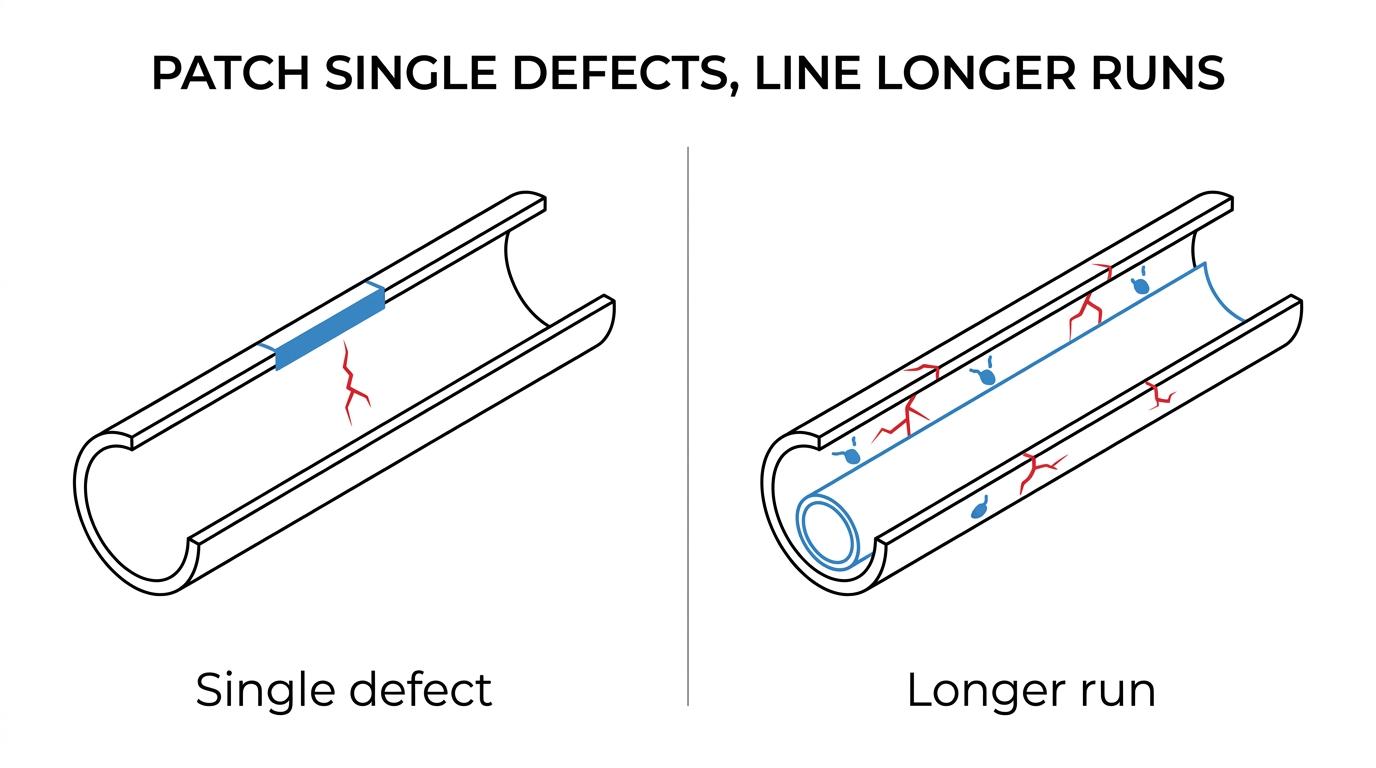
“Where several defects appear within a 30m section, we will discuss whether a part liner or full-length liner is better value than multiple separate patches.”
In practical terms, that means you get a repair plan that fits the pipe you have, rather than a one-size-fits-all recommendation. It also means we can explain upfront whether preparation work is likely before lining, which matters for both cost and programme.
| Drain condition | No dig repair option | What it improves |
|---|---|---|
| Single crack or isolated fracture | Localised patch repair | Repairs the point defect with minimal disturbance |
| Longer area of cracking or infiltration | CIPP lining | Creates a close-fit internal liner through a larger section |
| Defect at a property connection or lateral junction | Lateral repair or connection sealing | Restores the junction and helps prevent ingress or leakage |
| Multiple defects within one run | Part liner or full-length liner may be preferable | Reduces repeat interventions across the same section |
No dig does not mean ignoring the true condition of the host pipe. If there is extensive damage, significant infiltration, or repeated failures in one section, patching alone may not be the best long-term answer, and we will say so.
Lateral drain repair for property connections and junction defects
If the cracked section sits on a lateral, the pipe connecting your property to the main sewer, trenchless lateral repair can often extend the working life of that connection while reducing disruption to the property owner. That matters when the defect is under extensions, paths, patios, parking areas, or other difficult-to-dig locations.
Where the issue is around the lateral connection itself, no dig repair may involve connection sealing or a top hat style repair. In trenchless rehabilitation, a top hat seal is a pre-prepared T-shaped resin-impregnated CIPP material positioned at the lateral connection to seal the junction between the main pipe and the branch.
This is one reason proper inspection matters. A crack in the pipe barrel, a leaking joint, and a defective lateral connection can all look similar at first glance, but they are not best treated in the same way.
Our no dig drain repair process for cracked pipe issues
We keep the process clear, because most customers want to know three things quickly: what is wrong, whether it can be repaired without digging, and what they are likely to spend to put it right.
“If a pipe is deformed by more than 10% of its nominal diameter, re-rounding is usually needed before lining, and we will explain that before any repair starts.”
A typical no dig drain repair service includes the following stages:
- Inspection: We identify whether the defect is a local crack, fracture, infiltration point, deformation issue, or lateral connection problem.
- Cleaning and preparation: The pipe may need cleaning or other preparation so the repair can bond and cure properly.
- Method selection: We recommend localised patch repair, CIPP lining, lateral repair, or a fuller rehabilitation approach based on the defect pattern.
- Installation: The selected trenchless repair is installed within the existing pipe using the appropriate packer, liner, or connection sealing method.
- Verification: We confirm the repaired section and check that the drain is restored to service.
What you gain from that process is clarity. You know whether the cracked pipe can be repaired locally, whether a larger liner is more sensible, and whether excavation should still be on the table because the host pipe condition makes trenchless work poor value.
When no dig drain repair is the right fit, and when it is not
No dig drain repair is usually the right fit when the damage can be treated locally or when the pipe can be lined without first replacing the run. It is often a strong option when you want to avoid unnecessary excavation and the defect sits in a difficult or sensitive location.
It is commonly suitable in situations such as these:
- Isolated cracks or fractures: A localised repair can target the defective section directly.
- Infiltration into a gravity drain or sewer: CIPP lining is one of the principal methods used to seal pipes and reduce discharges to the environment.
- Defects on laterals: Patch repairs, lining, and connection sealing can reduce the impact of work on the property.
- Sites where access disruption matters: Trenchless work typically needs less equipment, less manpower, and a smaller site footprint than open excavation.
It may be the wrong fit if the pipe is heavily deformed, extensively damaged, or has too many defects across one section for isolated repairs to make sense. In those cases, preparatory work such as re-rounding, or a part liner, full-length liner, or excavation-based solution, may deliver a more reliable outcome.
Price clarity and honest recommendations for trenchless drain repair
One of the biggest concerns with any cracked drain repair is whether the quoted method will still be the right one once the pipe is fully inspected. We deal with that by basing the recommendation on the defect itself and explaining what could change the scope, such as deformation, repeated defects in one run, or issues at the lateral connection.
That matters because the lowest initial option is not always the best value. A single patch may be economical for one point defect, but if the same 30 metre section contains several defects, a liner may be the more efficient and longer-lasting choice.
You should also expect a straightforward answer if no dig repair is not appropriate. A trustworthy drainage recommendation is not one that forces every cracked pipe into a lining solution. It is one that tells you when trenchless repair is the right fit, when preparation is needed first, and when excavation will serve you better.
Arrange a cracked drain assessment and find out if no dig repair is possible
If you are dealing with a cracked drain and want to avoid unnecessary excavation, the next step is to have the defect assessed properly. We can review the problem, identify whether it is a point defect, a longer damaged section, or a lateral connection issue, and advise on the most suitable no dig repair route.
Get in touch to discuss your cracked pipe issue and arrange an assessment. If trenchless repair is viable, we will explain whether a localised patch, CIPP lining, or lateral repair is the best way to restore the drain with the least disruption.