
Older properties sometimes contain underground drainage systems made from materials that are rarely used in modern installations. One example is pitch fibre drain pipes, which were widely installed in the UK during the mid-20th century. These lightweight pipes were designed to carry wastewater away from buildings, but ageing materials and ground conditions can affect their performance.
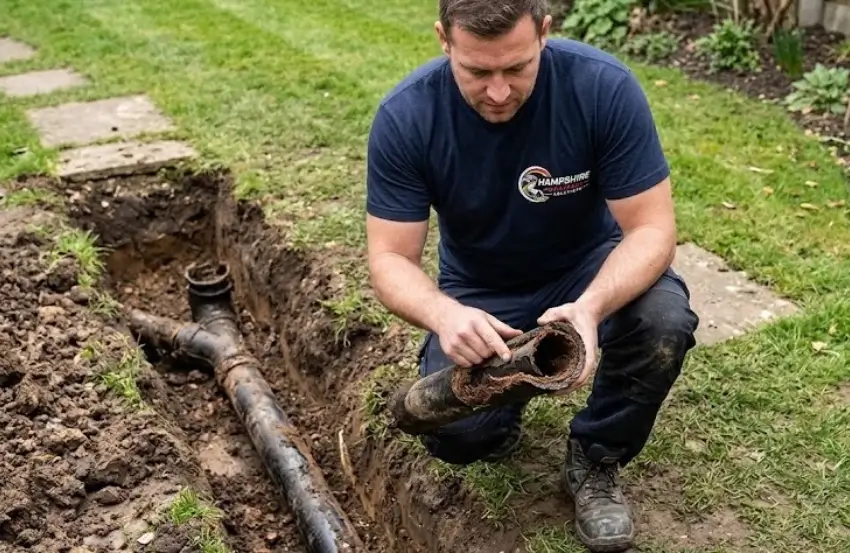
Pitch fibre pipes are made from compressed cellulose fibres impregnated with bitumen-based pitch. Their structure forms a relatively lightweight, water-resistant pipe that allows wastewater to flow through an underground drainage network. Unlike modern plastic drainage pipes, however, pitch fibre can soften, deform or deteriorate over time.
Understanding how these pipes work is particularly important for homeowners dealing with recurring blockages, slow drainage or suspected underground pipe damage.
At Hampshire Drain Expert, we help property owners in Hampshire investigate drainage concerns through services such as CCTV drain surveys, drain clearance and drainage repairs.
This guide explains how pitch fibre pipes were manufactured, why problems develop, how to recognise potential warning signs and when professional inspection, repair or replacement may be necessary.
What Are Pitch Fibre Drain Pipes Made From?
Pitch fibre drainage pipes are manufactured using compressed organic fibres, commonly cellulose-based materials, treated with a bituminous compound.
The manufacturing process creates a relatively lightweight pipe with a water-resistant structure. The pitch coating helps protect the compressed fibres against moisture while allowing wastewater to pass through the drainage system.
These pipes were used in Britain particularly during the 1950s, 1960s and 1970s, although installation dates vary between properties.
Why Were Pitch Fibre Pipes Popular?
Pitch fibre pipes offered several practical advantages when they were introduced.
- Lightweight construction: Easier handling and transportation compared with heavier drainage materials.
- Simple installation: Their weight made them relatively convenient to position underground.
- Corrosion resistance: The bituminous material was not susceptible to rust in the same way as unprotected metal.
- Economical production: They provided an alternative to traditional clay and other drainage pipe materials.
- Smooth internal surface: An intact pipe could transport wastewater effectively through the drainage network.
However, their long-term structural performance can be affected by deterioration, loading and environmental conditions.
How Do Pitch Fibre Drain Pipes Work?
Pitch fibre drains operate using the same basic principle as many conventional underground gravity drainage systems.
Wastewater enters the drainage network through connected fixtures such as toilets, sinks, baths and showers. The water then travels through pipes laid at an appropriate gradient towards the relevant sewer or wastewater disposal system.
The internal surface of the pipe allows wastewater and suspended waste to pass through.
The Role of Gravity in Wastewater Drainage
Most domestic underground drainage systems depend on gravity rather than mechanical pumping.
A correctly installed pipe needs an appropriate fall to keep wastewater moving without allowing solids to accumulate unnecessarily.
Several factors influence performance, including pipe diameter, gradient, internal condition and the number of connections.
When pitch fibre pipework remains structurally sound, wastewater can flow through it normally.
However, deterioration may change the shape of the pipe and reduce its effective internal diameter.
Why Pipe Shape Matters
An underground drain is generally designed with a circular cross-section.
A circular pipe provides a consistent passage for wastewater and helps distribute external loads through its structure.
When pitch fibre pipes deform, their circular shape may become flattened or oval.
This condition is sometimes called ovalisation.
A reduced opening can restrict wastewater movement and create locations where toilet paper, grease and other debris accumulate.
Repeated blockages may develop even after an initial obstruction has been cleared.
What Are the Most Common Pitch Fibre Drain Pipe Problems?
Pitch fibre drain pipe problems can develop gradually and may remain unnoticed until drainage performance changes.
Some defects affect only a small section of pipework, while others involve extensive deterioration.
1. Pipe Deformation and Flattening
One of the best-known problems associated with ageing pitch fibre drainage is deformation.
Over time, the pipe may lose its original circular profile.
External ground pressure, installation conditions, material deterioration and sustained loading can contribute to changes in shape.
A flattened pipe provides less space for wastewater to travel through.
Consequently, debris may collect inside the drain, increasing the risk of recurring blockages.
2. Internal Delamination
Delamination occurs when layers within the pipe structure begin to separate.
The internal surface may become uneven, damaged or partially detached.
These changes can interrupt the smooth movement of wastewater and provide places where debris accumulates.
The Financial Ombudsman Service’s guidance on underground pipe damage, including pitch fibre delamination provides further information about these defects in the context of insurance complaints.
3. Structural Cracking
Ageing pitch fibre pipework may develop cracks or other structural defects.
Cracking can occur alongside deformation, ground movement or damage to the surrounding drainage system.
Not every crack means the entire drainage run requires replacement. The severity, location and extent of the defect need to be assessed.
4. Recurring Drain Blockages
A blocked drain is not automatically evidence of damaged pitch fibre pipework.
Common blockages can also result from grease, unsuitable materials being flushed or other obstructions.
However, repeated blockages in the same location may indicate an underlying structural issue.
Clearing the immediate obstruction without investigating the pipe condition may provide only temporary relief.
5. Root Intrusion and Joint Problems
Tree roots can enter underground drains through defective joints or openings in damaged pipework.
Once inside, roots may trap debris and contribute to further blockages.
Root intrusion can affect several types of drainage material, not only pitch fibre.
A CCTV drain survey can help identify whether roots are present and whether the surrounding pipe structure has deteriorated.
Pitch Fibre Drain Problems: Symptoms and Possible Causes
| Warning sign | Possible underlying issue | Recommended next step |
|---|---|---|
| Repeated blockages | Deformed pipe or internal obstruction | Arrange a CCTV drain survey |
| Slow wastewater drainage | Restricted internal pipe diameter | Investigate the affected drainage run |
| Gurgling toilets or sinks | Partial blockage or drainage airflow issue | Check for connected drainage problems |
| Unpleasant drain smells | Trapped waste, defective joints or another drainage fault | Identify the source before repairing |
| Water backing up | Significant blockage or restricted flow | Stop using affected fixtures and seek assistance |
| Visible pipe flattening on CCTV | Structural deformation | Assess repair or replacement suitability |
| Root intrusion | Defective joints or openings | Inspect the affected pipe section |
These symptoms are not exclusive to pitch fibre drains. Accurate diagnosis is important before selecting a repair method.
How Can You Tell Whether Your Property Has Pitch Fibre Drain Pipes?
Identifying underground drainage materials without excavation can be difficult.
Older properties may contain several different pipe materials because sections have been repaired or replaced over time.
A house built during the period when pitch fibre was commonly installed may contain these pipes, but the building’s age alone cannot confirm their presence.
Check Existing Drainage Records
Previous drainage survey reports, renovation documents or property maintenance records may identify the materials used underground.
Records from earlier repairs can also reveal whether sections of the drainage network have already been replaced.
Arrange a CCTV Drain Survey
A CCTV drain survey is a useful way to investigate suspected pitch fibre drainage.
A specialist drainage camera is introduced into an accessible section of the system to inspect the internal pipe condition.
The inspection may reveal:
-
Pipe deformation or flattening
-
Cracks and damaged sections
-
Internal delamination
-
Root intrusion
-
Debris accumulation
-
Joint displacement
-
Evidence of previous repairs
A camera inspection can help identify characteristics consistent with pitch fibre, although material identification may sometimes require additional confirmation.
For further information, explore our CCTV drain survey services to understand the condition of your underground pipework.
Can Pitch Fibre Drain Pipes Be Repaired?
Yes. Pitch fibre drain pipe repair may be possible when the existing pipe retains sufficient structural integrity.
The appropriate repair depends on the severity of deformation, the location of defects, the pipe’s condition and whether the drainage run can be accessed safely.
Some damaged sections can be repaired without replacing the entire underground drainage network.
However, severely flattened or collapsed pipes may need excavation and replacement.
Drain Cleaning and Clearance
Where the pipe remains structurally sound, professional drain clearance may remove accumulated debris and restore wastewater flow.
This can address an immediate blockage, but it does not correct deformation or deterioration within the pipe material.
Repeated cleaning should not be treated as a permanent structural repair.
Structural Pipe Relining
Drain relining involves installing a new lining within suitable existing pipework.
Depending on the system and the condition of the original pipe, a cured-in-place lining can create a new internal pipe surface.
Relining may be suitable for some damaged drains, but pitch fibre requires careful assessment.
Severe deformation, instability or insufficient internal space can make lining impractical without additional work.
Localised Pipe Repairs
A localised repair may be appropriate when damage is confined to a relatively short section.
The feasibility depends on access, pipe geometry and the surrounding structural condition.
A drainage specialist should establish whether the remaining pipework is suitable for continued use.
When Is Pitch Fibre Drain Pipe Replacement Necessary?
Pitch fibre drain pipe replacement may be the more appropriate solution when deterioration is extensive or the pipe has lost its structural shape.
Replacement involves removing or bypassing the defective drainage section and installing suitable new pipework.
Modern underground drainage systems commonly use materials such as uPVC, although the correct specification depends on the installation.
Situations Where Replacement May Be Recommended
Replacement may be considered when:
-
The pipe has collapsed or become severely flattened.
-
Extensive deformation prevents effective wastewater flow.
-
Multiple structural defects affect the same drainage run.
-
The existing pipe cannot support an appropriate lining.
-
Previous repairs have not resolved the underlying problem.
-
The drainage layout requires significant alteration.
A replacement recommendation should be based on inspection findings rather than the age of the pipe alone.
Repair Versus Replacement: Which Is Better?
| Consideration | Drain repair or relining | Drain replacement |
|---|---|---|
| Typical suitability | Localised defects or structurally suitable pipes | Severe damage or widespread deterioration |
| Excavation | May be reduced or avoided | May require excavation |
| Existing pipe shape | Adequate geometry often needed | Damaged pipe can be removed or bypassed |
| Disruption | Depends on access and repair method | Depends on depth, location and site conditions |
| Long-term outcome | Depends on material and repair suitability | Provides a new pipe section |
| Best decision basis | CCTV findings and structural assessment | CCTV findings and replacement feasibility |
Neither approach is automatically the best option for every property.
A professional assessment can help avoid unnecessary excavation while ensuring significant defects are addressed properly.
How Long Do Pitch Fibre Drain Pipes Last?
There is no single reliable lifespan that applies to every pitch fibre drainage installation.
Performance depends on several factors, including manufacturing quality, installation conditions, ground loading, wastewater characteristics and previous maintenance.
Many pitch fibre pipes installed decades ago are now well beyond their original installation period.
Some may continue functioning, while others develop substantial deformation or deterioration.
The most useful way to assess an existing system is to examine its actual condition.
Factors That Affect Pipe Longevity
Ground pressure can contribute to deformation, particularly where the pipe has lost structural strength.
Changes in surrounding soil conditions may also affect the drainage system.
Poor installation, inadequate support and heavy loading can create additional problems.
The condition of joints and connections matters as well, because defects may allow roots or surrounding material to enter.
Regular inspection is particularly useful when an older drainage system begins showing repeated symptoms.
Are Pitch Fibre Drain Pipes Dangerous?
Pitch fibre pipes are not automatically dangerous simply because they are present underground.
The main concerns relate to drainage performance and structural deterioration.
A damaged drain can allow wastewater to escape, contribute to blockages or cause sewage to back up into connected fixtures.
Escaping wastewater may also affect surrounding ground conditions.
What About Asbestos?
Pitch fibre drainage pipes should not automatically be described as asbestos pipes.
Pitch fibre and asbestos cement are different pipe materials.
However, older buildings can contain several historic construction materials, and identification should not rely on appearance alone.
Where a material is uncertain or asbestos is suspected, avoid cutting, drilling or disturbing it until an appropriate assessment has been completed.
The Health and Safety Executive asbestos guidance provides information about managing potential asbestos risks.
How Can Homeowners Prevent Pitch Fibre Drain Problems?
Preventive maintenance cannot reverse deterioration in an ageing pipe.
However, sensible drainage habits can reduce avoidable blockages and help identify problems earlier.
Keep Grease and Food Waste Out of Drains
Cooking fats, oils and grease can accumulate inside drainage pipes.
As deposits build up, they reduce the available space for wastewater to flow.
Allow cooking fat to cool and dispose of it appropriately rather than pouring it down the sink.
Avoid Flushing Unsuitable Materials
Toilets should not be used to dispose of wet wipes, sanitary products, cotton buds or other unsuitable materials.
Even products marketed as flushable can contribute to drainage problems.
Older pipework with internal deformation may be particularly vulnerable to accumulating debris.
Respond to Repeated Warning Signs
Occasional slow drainage does not necessarily indicate structural failure.
However, recurring problems deserve investigation, especially when several fixtures are affected.
A professional inspection can distinguish an ordinary blockage from a damaged pipe.
Avoid Aggressive DIY Drain Treatments
Strong chemical drain cleaners may create handling hazards and are unlikely to correct structural pipe defects.
Do not attempt to enter a manhole, cut unknown underground pipe materials or use high-pressure equipment without appropriate training.
Professional diagnosis is safer when the condition of an older drain is uncertain.
Who Is Responsible for Pitch Fibre Drain Repairs?
Responsibility depends on the location and legal status of the affected drainage pipe.
In England, property owners are generally responsible for private drains within their responsibility, while sewerage companies usually maintain public sewers and many shared lateral drains.
The distinction is important because a pipe serving more than one property may fall under different maintenance arrangements.
Property boundaries alone do not always determine responsibility.
For guidance on maintenance responsibilities, read CCW’s advice on who is responsible for drains and sewers.
For a suspected shared drainage problem, the relevant sewerage undertaker should be contacted before arranging private repair work.
Pitch Fibre Drainage in Older Hampshire Properties
Properties across Hampshire may contain drainage systems installed during different periods of residential and commercial development.
Some older buildings in Southampton, Portsmouth, Winchester and surrounding areas may have undergone multiple drainage alterations over the years.
This can result in a combination of historic and modern pipe materials within the same property.
However, the presence of pitch fibre should never be assumed solely from a property’s location or construction date.
Why Local Drainage Surveys Matter
A drainage survey can be particularly useful before purchasing an older property, carrying out building work or investigating persistent wastewater problems.
The survey findings may help property owners understand whether the system requires maintenance, repair or further investigation.
Hampshire Drain Expert provides drainage services in Hampshire, including CCTV drain surveys, drain clearance and repair enquiries.
For properties with suspected pitch fibre deterioration, a condition assessment is a sensible starting point before choosing a repair method.
When Should You Contact a Professional Drainage Specialist?
Professional assistance is appropriate when drainage problems keep returning or when there are signs of structural pipe damage.
A specialist can investigate the drainage system and help establish whether the problem relates to an obstruction, pipe deformation, damaged joints or another fault.
Seek prompt assistance when sewage backs up into the property, wastewater escapes from a drain or essential drainage fixtures cannot be used safely.
Where wastewater is overflowing, avoid contact with contaminated water and limit use of affected fixtures until the issue has been assessed.
You can contact Hampshire Drain Expert to discuss suspected underground drainage problems and the appropriate next steps.
Frequently Asked Questions About Pitch Fibre Drain Pipes
1. How do I know whether my drains are made from pitch fibre?
Older drainage records may identify the pipe material, but a professional CCTV drain survey is often a useful starting point. It can reveal internal features, deformation and defects consistent with pitch fibre. Additional confirmation may be necessary.
2. Can pitch fibre drain pipes be relined?
Some pitch fibre pipes can be relined when their structural condition and internal shape are suitable. Severely flattened or collapsed pipes may require additional work or replacement. A CCTV inspection helps determine the appropriate option.
3. Do all pitch fibre drains need replacing?
No. Replacement is not automatically necessary because a pipe is made from pitch fibre. The decision depends on its current condition, drainage performance and the severity of any structural defects.
4. Why do pitch fibre drain pipes become flattened?
Flattening can result from material deterioration combined with external ground loading, inadequate support or other installation conditions. The resulting deformation reduces the internal opening and may contribute to recurring blockages.
5. Can a blocked pitch fibre drain be cleared without excavation?
Some blockages can be cleared without excavation, provided the pipe condition allows safe access and an appropriate clearance method. However, clearing a blockage does not repair structural deformation. Further inspection may be required to prevent recurring problems.
Conclusion: Understanding and Maintaining Pitch Fibre Drain Pipes
Pitch fibre drain pipes were an important part of historic UK drainage installations, but their ageing structure can present challenges for modern property owners.
Deformation, internal delamination, cracking and recurring blockages are among the issues that may affect these pipes.
Not every pitch fibre drain needs replacing. Some can continue functioning, while others may be suitable for targeted repairs or relining.
The most important step is establishing the condition of the underground pipework before making a repair decision.
Need Help With an Older Drainage System in Hampshire?
Recurring blockages, slow drainage or suspected pipe damage can be signs that your drainage system needs closer investigation.
Hampshire Drain Expert can help you explore CCTV drain survey, drain clearance and repair options for your property.
Call or visit Hampshire Drain Expert to request a drainage assessment.