
Keeping drainage systems working properly is an important part of managing any commercial property. A blocked drain, overflowing inspection chamber or recurring wastewater problem can interrupt daily operations, affect hygiene and lead to avoidable repair work. A structured maintenance approach helps businesses identify potential problems before they become disruptive.
A commercial drainage maintenance plan should include an assessment of the drainage system, routine inspections, scheduled cleaning, blockage prevention measures, clear maintenance responsibilities, emergency procedures and accurate service records. The frequency and scope of maintenance should reflect the property’s drainage layout, daily usage, previous faults and operational risks.
For restaurants, offices, retail premises, warehouses and other commercial buildings, preventative maintenance is generally more practical than relying entirely on emergency drain clearance. Regular checks can reveal developing blockages, damaged pipework and drainage conditions that require professional attention.
At Hampshire Drain Expert, we help businesses across Hampshire understand and manage their drainage requirements through commercial drainage services, inspections and maintenance support. This guide explains the essential elements of a drainage maintenance plan, how to organise inspections and cleaning, and when specialist assistance is appropriate.
Why Is a Commercial Drainage Maintenance Plan Important?
Commercial drainage systems often experience different demands from domestic pipework. Restaurants may discharge wastewater containing fats and food residues, while offices, warehouses and retail buildings can have multiple toilets, sinks, gullies and external drainage connections.
The risk is not simply that a drain becomes blocked. A drainage fault can affect several areas of a building, particularly where multiple fixtures share the same pipework.
A planned approach provides a clearer understanding of the drainage system and helps property managers make maintenance decisions based on actual conditions.
Reducing unexpected drainage problems
Drainage blockages often develop gradually. Grease, sediment, wipes and other unsuitable materials can accumulate inside pipes before wastewater begins to drain slowly.
Routine checks and appropriate cleaning can help identify these conditions early.
Supporting business continuity
An overflowing toilet or blocked commercial kitchen drain may require an area to be taken out of use while the problem is investigated.
Preventative drainage maintenance for businesses helps reduce avoidable disruption, although no maintenance programme can eliminate every unexpected fault.
Improving maintenance budgeting
Planned inspections allow businesses to anticipate routine work and identify developing repair requirements.
This can make maintenance expenditure easier to manage than responding only after a serious blockage or pipe failure.
Maintaining suitable hygiene conditions
Wastewater backups and foul odours can affect working environments, customer facilities and food-handling areas.
A documented maintenance programme helps managers demonstrate that drainage risks are being monitored and addressed.
What Are the Essential Components of a Commercial Drainage Maintenance Plan?
A useful maintenance plan should be specific to the building rather than relying on a generic cleaning schedule.
The following elements provide a practical starting point.
1. Initial Drainage System Assessment
The first stage is understanding what drainage assets exist, how they connect and where problems are most likely to occur.
An initial assessment should establish the condition and operational importance of the drainage system.
Identify drainage assets
Depending on the property, the assessment may cover:
-
Internal foul-water pipework and connected fixtures.
-
External drains and inspection chambers.
-
Surface-water gullies and drainage channels.
-
Manholes and accessible pipe connections.
-
Grease management equipment, where installed.
-
Drainage pumps or other specialist equipment, where present.
-
Known shared drains and sewer connections.
The assessment should also establish which assets the business is responsible for maintaining.
In England, responsibility for drainage can depend on pipe location, ownership and whether a drain serves more than one property. Some shared sewers are maintained by the relevant sewerage undertaker.
Review previous drainage problems
Maintenance records, previous survey reports and staff observations can reveal recurring issues.
For example, repeated blockages in the same section of pipework may indicate a structural defect, poor pipe alignment or a persistent build-up of material.
These problems may require further investigation rather than repeated cleaning alone.
2. Routine Commercial Drainage Inspections
Regular inspections are central to a preventative maintenance programme.
Their purpose is to identify early warning signs and determine whether cleaning, monitoring or repair work is necessary.
What should inspections cover?
An inspection should consider:
-
Slow drainage from sinks, toilets and floor outlets.
-
Gurgling noises from connected fixtures.
-
Unpleasant smells around drainage points.
-
Water collecting near external gullies.
-
Evidence of previous wastewater overflow.
-
Accessible inspection chambers showing restricted flow.
-
Visible leaks, damaged fittings or displaced covers.
Staff can report many of these symptoms during normal operations. However, entering manholes, confined spaces or drainage chambers should be left to appropriately trained professionals.
When is a CCTV drain survey appropriate?
A CCTV drain survey can help investigate hidden pipework problems that cannot be identified through visual inspection alone.
Camera inspections may reveal:
-
Cracked or fractured drainage pipes.
-
Tree-root intrusion.
-
Displaced joints.
-
Obstructions and accumulated deposits.
-
Pipe deformation or deterioration.
-
Areas where wastewater is not flowing correctly.
CCTV surveys are particularly useful when a business experiences recurring blockages or needs evidence before deciding whether pipe repairs are necessary. Not every drainage system needs a camera survey at every maintenance visit. The decision should be based on risk, previous problems and the condition of the pipework.
3. Scheduled Commercial Drain Cleaning
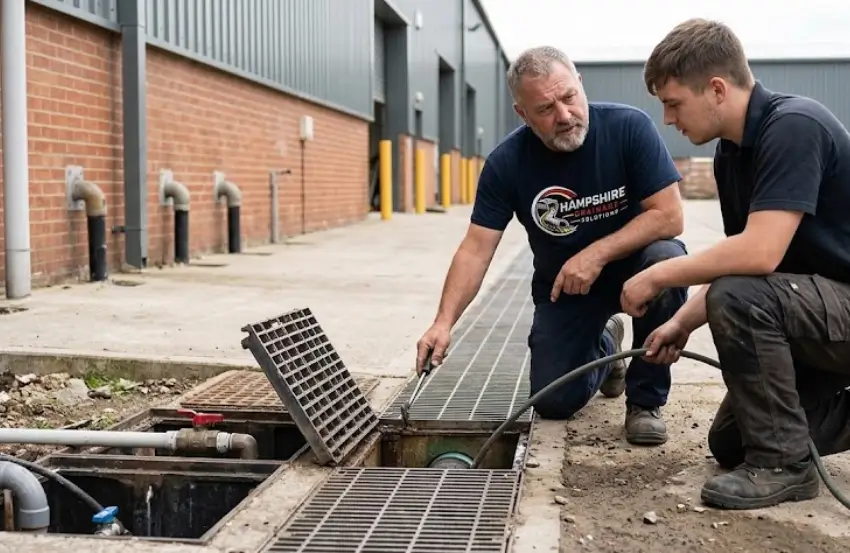
Scheduled cleaning is an important part of preventative maintenance. Professional drain clearance services can help remove accumulated debris and obstructions that restrict wastewater flow. The appropriate cleaning method and frequency should depend on the condition and usage of the drainage system.
Cleaning is another important part of commercial drain maintenance services. Over time, wastewater pipes can accumulate deposits that restrict their internal diameter. The type of build-up depends on how the building is used. For example, commercial kitchens may experience fat and grease deposits, while external drainage systems may collect silt, leaves and other debris.
How should cleaning be scheduled?
Scheduled commercial drain cleaning should focus on sections of the system where deposits are likely to develop.
The appropriate cleaning interval depends on:
-
How frequently the drainage system is used.
-
The type of wastewater entering the drains.
-
Previous blockage history.
-
Pipe diameter, condition and accessibility.
-
The amount of grease, sediment or other material present.
-
The consequences of a drainage failure.
High-use drainage systems may need more frequent attention than lightly used facilities.
What cleaning methods might be required?
Professional cleaning methods may include mechanical blockage removal or water jetting, depending on the pipework and the nature of the obstruction. The correct method should be selected after considering pipe condition and safety.
Aggressive cleaning techniques can damage vulnerable drainage systems when applied without a suitable assessment.
4. A Risk-Based Drainage Maintenance Schedule
A maintenance plan should establish when inspections, cleaning and reviews will take place. There is no universal maintenance interval suitable for every commercial building. The following table provides an illustrative planning framework, not a mandatory schedule.
| Maintenance activity | Suggested review approach | Purpose |
|---|---|---|
| Staff drainage observations | During routine operations | Identify obvious problems early |
| Accessible drain and gully checks | Periodically and after relevant weather events | Spot debris and standing water |
| Professional drainage inspection | According to property risk | Assess system condition |
| Scheduled drain cleaning | Based on usage and deposit build-up | Reduce blockage risk |
| CCTV drain survey | Following recurring faults or where condition evidence is needed | Investigate hidden defects |
| Maintenance record review | After work and during planned reviews | Identify recurring issues |
| Emergency procedure review | When contacts, responsibilities or building use change | Keep response arrangements current |
A restaurant, warehouse and small office may require very different schedules. The maintenance programme should be reviewed whenever the building’s usage changes or drainage problems become more frequent.
5. Drainage Blockage Prevention Measures
Preventative drainage maintenance for businesses should address the materials entering the drainage system, not simply the condition of the pipes. Repeated cleaning may provide only temporary relief when the underlying cause remains unchanged.
Commercial kitchens and food premises
Kitchen drainage systems can be affected by fats, oils, grease and food waste. Businesses should use appropriate waste disposal procedures and maintain any installed grease management equipment in accordance with its requirements. Pouring hot water or chemicals into a drain is not a reliable way to resolve accumulated grease deposits.
Food businesses should also follow appropriate grease and waste disposal practices. Water UK provides industry information about fats, oils and grease, while Thames Water offers guidance on preventing drainage blockages caused by unsuitable waste disposal.
Offices and public facilities
Shared toilet facilities may experience blockages caused by unsuitable materials.
Clear signage and suitable waste bins can help discourage the disposal of wipes, sanitary products and other non-flushable items.
Warehouses and external drainage areas
External gullies and channels can collect packaging materials, leaves, dirt and sediment.
Keeping these areas clear of loose debris can reduce the likelihood of material entering the drainage network.
A drainage maintenance plan should also identify any specialist site-specific requirements, such as trade effluent controls or pollution-prevention arrangements.
6. Drain Repairs and Structural Maintenance
Drain cleaning and drain repair serve different purposes.
Cleaning removes deposits and obstructions. Repairs address defects in the pipework or drainage infrastructure.
Where an inspection identifies a damaged pipe, the maintenance plan should record the defect, assess its significance and establish the next action.
When might drain repairs be necessary?
Possible warning signs include:
-
Repeated blockages in the same location.
-
Persistent wastewater leakage.
-
Cracked or displaced pipe joints.
-
Root intrusion through damaged sections.
-
Localised ground movement associated with a suspected leak.
-
Structural defects identified during a CCTV survey.
Depending on the pipe condition and access requirements, professional solutions may include targeted repairs, patch lining, pipe relining or replacement.
A suitable repair method should be determined by the actual defect rather than chosen solely to avoid excavation.
7. Emergency Drainage Response Procedures
Even a well-maintained drainage system can experience unexpected problems.
A commercial drainage maintenance plan should therefore explain what staff must do when wastewater backs up, a drain overflows or a drainage system stops functioning.
What should an emergency procedure include?
The procedure should identify:
-
Who is responsible for reporting drainage faults.
-
Who can authorise emergency drainage work.
-
How to isolate affected facilities or work areas safely.
-
Where drainage plans and maintenance records are stored.
-
How to contact the appropriate drainage contractor.
-
When the water company, landlord or other responsible party should be contacted.
-
How incidents and corrective actions will be documented.
Staff should avoid attempting to enter drainage chambers or dismantle complex drainage equipment without appropriate training.
Wastewater may contain harmful microorganisms, and some drainage environments present additional safety risks.
For urgent drainage problems in Hampshire, businesses can contact Hampshire Drain Expert to discuss the situation and appropriate next steps.
8. Drainage Maintenance Records and Documentation
A maintenance programme becomes more useful when inspections and repairs are properly recorded.
Without documentation, property managers may struggle to establish which sections of the drainage system have been inspected or whether a recurring problem has already been investigated.
What information should be recorded?
A practical maintenance log should include:
| Record | Information to include |
|---|---|
| Inspection date | When the drainage system was checked |
| Asset location | Which drain, chamber or pipe section was inspected |
| Condition | Observed defects, deposits or restrictions |
| Work completed | Cleaning, inspection, clearance or repair |
| Supporting evidence | CCTV footage, photographs or relevant reports |
| Recommendations | Further investigation or corrective action |
| Responsibility | Person or contractor assigned to the action |
| Follow-up | Planned date or trigger for the next review |
Records can also help identify patterns.
For example, a drain that requires repeated clearance within a short period may need further investigation rather than simply a shorter cleaning interval.
9. Assigning Drainage Maintenance Responsibilities
Commercial drainage maintenance often involves several parties.
Depending on the property arrangement, responsibility may be shared between a landlord, tenant, facilities manager, managing agent, maintenance contractor and sewerage undertaker.
The plan should make these responsibilities clear.
Property owners and landlords
Owners may be responsible for certain structural drainage assets, subject to tenancy agreements and relevant legal obligations.
Tenants and business operators
Occupiers may be responsible for correct day-to-day use of drainage facilities, reporting problems and maintaining particular equipment.
Facilities managers
Facilities managers may coordinate inspections, contractors, maintenance budgets, records and emergency arrangements.
Drainage specialists
Professional drainage contractors can investigate blockages, assess pipe condition and recommend appropriate maintenance or repair work.
Written responsibilities reduce confusion when urgent action is required.
10. Reviewing and Updating the Maintenance Plan
A commercial drainage maintenance plan should not remain unchanged indefinitely.
The system’s maintenance requirements may change as a property develops or its occupancy changes.
For example, converting a retail unit into a food business can alter wastewater characteristics and place different demands on existing pipework.
When should a maintenance plan be reviewed?
Review the plan when:
-
A recurring drainage problem develops.
-
A CCTV inspection identifies structural defects.
-
The building changes use or occupancy.
-
Additional toilets, sinks or kitchen equipment are installed.
-
Drainage alterations or repairs are completed.
-
Flooding or a significant drainage incident occurs.
-
The existing cleaning schedule proves insufficient.
A review should consider whether the current inspection and cleaning programme is still appropriate.
How Do Drainage Maintenance Needs Differ Between Commercial Properties?
Different businesses generate different drainage risks.
A suitable maintenance programme should reflect those differences rather than applying the same checklist to every property.
| Commercial property | Common drainage considerations | Maintenance priority |
|---|---|---|
| Restaurants and commercial kitchens | Fats, oils, grease and food waste | Grease control and cleaning |
| Offices | Toilets, washrooms and shared facilities | Usage monitoring and blockage prevention |
| Retail premises | Customer facilities and external drainage | Routine checks and incident reporting |
| Warehouses | Yard gullies, sediment and surface water | External drainage inspections |
| Hotels and hospitality buildings | Multiple bathrooms, kitchens and high occupancy | Coordinated inspections and cleaning |
| Managed commercial properties | Multiple occupiers and shared drainage assets | Clear responsibilities and records |
The table describes common considerations. Actual risks must be assessed for each site.
Commercial Drainage Maintenance for Hampshire Businesses
Businesses across Hampshire operate in a wide range of properties, from office buildings and retail premises to restaurants, warehouses and mixed-use commercial sites.
Drainage maintenance requirements can vary significantly between these buildings, even when they are located in the same town.
In Southampton and Portsmouth, commercial properties may have busy customer facilities, kitchens or external drainage areas that require regular monitoring.
Businesses in Winchester, Basingstoke and Eastleigh may also need maintenance arrangements that reflect their building layout, occupancy and existing drainage condition.
For property managers responsible for several sites, consistent inspection records and clear maintenance responsibilities are particularly valuable.
Hampshire Drain Expert provides commercial drainage support for businesses in Hampshire. Our drainage services can help property managers investigate existing faults and plan suitable maintenance activities.
The starting point should always be the actual condition and usage of the drainage system rather than assumptions based solely on the property’s location.
How Can Businesses Create a Practical Drainage Maintenance Checklist?
A written checklist makes routine drainage management easier to organise and review.
The following checklist can be adapted to suit an individual commercial property.
Commercial drainage maintenance checklist
This checklist should form part of a broader property maintenance process rather than replace a site-specific professional assessment.
Frequently Asked Questions
1. How often should commercial drains be maintained?
Commercial drain maintenance frequency depends on wastewater usage, pipe condition, previous blockages and the consequences of a drainage failure. Higher-risk systems may need more frequent inspections and cleaning. A professional assessment can help establish a suitable schedule.
2. What does a commercial drainage maintenance plan include?
A commercial drainage maintenance plan includes drainage asset identification, risk assessments, routine inspections, scheduled cleaning, blockage prevention, repair procedures, emergency contacts and maintenance records. The plan should also specify responsibilities and review dates.
3. Do commercial properties need regular CCTV drain surveys?
Not every commercial property requires routine CCTV surveys at fixed intervals. Camera inspections are particularly useful for recurring blockages, suspected pipe damage and assessing hidden drainage defects. Survey requirements should reflect the property’s drainage risks.
4. Can preventative maintenance stop all commercial drain blockages?
Preventative maintenance can reduce the risk of avoidable blockages but cannot guarantee that every drainage problem will be prevented. Unexpected pipe damage, unsuitable waste disposal and other factors can still cause drainage failures.
5. Who is responsible for commercial drainage maintenance?
Responsibility depends on the drainage asset, property ownership, tenancy agreement and applicable legal arrangements. Landlords, tenants and property managers may have different duties, while some sewer connections fall under the relevant sewerage undertaker.
Conclusion: Building an Effective Commercial Drainage Maintenance Plan
A well-organised commercial drainage maintenance plan helps businesses understand their drainage systems, identify developing faults and reduce avoidable disruption.
The most effective approach combines routine inspections, appropriate cleaning, sensible waste management, maintenance records and clear emergency procedures. It also recognises that every commercial property has different drainage requirements.
Rather than treating each blockage as an isolated incident, businesses should review recurring problems and investigate their underlying causes.
For commercial properties across Hampshire, a structured maintenance programme can support safer facilities, more predictable maintenance planning and better drainage management.