
Hidden drainage faults can be difficult to identify because much of a property’s pipework is buried underground, concealed beneath floors or connected to inspection chambers outside. Water may appear in an unexpected location, drains may repeatedly block, or damp patches may develop without an obvious explanation.
Drain dye testing is a diagnostic method that uses a suitable coloured tracing dye to follow the movement of water through a drainage system. By introducing the dye at a selected point and observing where it appears, drainage specialists can investigate pipe connections, identify possible leakage routes and understand how wastewater travels through the network.
For homeowners and property managers in Hampshire, this method can help narrow down the source of drainage problems before deciding whether further investigation is necessary. It is particularly useful when a drainage connection is unclear or water is appearing somewhere it should not.
At Hampshire Drain Expert, we understand the importance of identifying the cause of a drainage issue before recommending a suitable solution. Depending on the symptoms and pipework involved, a drainage assessment may include CCTV inspection and other appropriate diagnostic methods. Understanding how dye testing works can help property owners make informed decisions about drainage investigations and repairs.
What Is Drain Dye Testing?
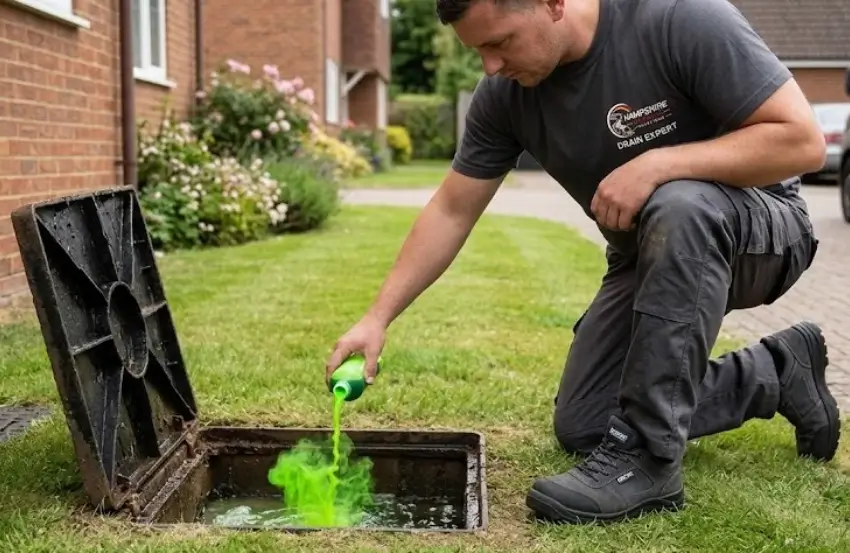
Drain dye testing is a technique used to investigate the route taken by water through drainage pipes and connected systems. It involves adding a specially selected tracing dye to water at a known entry point, then checking whether the coloured water appears at an expected outlet, inspection chamber or suspected leakage location.
The process can help establish whether two drainage points are connected and whether water is travelling along an anticipated route. Unlike methods that provide a direct image of the inside of a pipe, dye testing relies on observing water movement. It can therefore provide useful evidence about drainage connections without necessarily revealing the exact condition of the pipe walls.
Why Is Coloured Dye Used?
Drainage systems often contain several connected pipes serving kitchens, bathrooms, toilets, rainwater outlets and external drainage points. When water enters a shared system, identifying its source can be difficult.
A suitable tracing dye makes the water easier to distinguish from normal drainage flow. Different dye products and observation techniques may be used according to the investigation, including fluorescent dyes where appropriate.
Professional selection matters because not every dye is suitable for every drainage environment. The tracing product, concentration and method should be appropriate for the drainage system and the receiving environment.
How Does Drain Dye Testing Work?
The drainage dye testing procedure follows a controlled sequence intended to establish where water travels and whether the observed route matches the expected drainage layout.
For further information about how tracing dye works, read Stockport Council’s guidance on drain dye testing.
The investigator identifies suitable entry points, accessible inspection chambers and locations where coloured water might appear.
Step 2: Introduce the tracing dye
A measured quantity of appropriate dye is introduced into a selected drain or water flow, following the product’s instructions and the test plan.
Step 3: Observe the water movement
The investigator monitors accessible drainage points and suspected leakage locations to establish whether and where the coloured water emerges.
Step 4: Interpret the findings
Observations are compared with the expected pipe connections. Further investigation may be required when the results are inconclusive.
What Can the Results Tell You?
A successful test may confirm that water introduced at one point reaches a particular chamber or outlet. Coloured water emerging from an unexpected location can indicate a connection that needs further investigation.
However, the absence of visible dye does not automatically prove that a pipe is blocked, broken or disconnected. Dilution, limited access, water flow and the test’s observation period can all affect the result. For this reason, dye testing is best treated as one source of diagnostic evidence rather than a guaranteed way to identify every drainage defect.
What Drainage Problems Can Dye Testing Help Identify?
Drain dye testing can support investigations into several types of drainage problem, particularly where the route or destination of water is uncertain.
1. Suspected Leaks from Drainage Pipes
Drain dye testing for leaks may help establish whether wastewater from a particular drain is reaching a damp area, excavation or other observable location. For example, coloured water appearing near a suspected defective pipe could strengthen the evidence that the pipework is contributing to the problem. Nevertheless, dye testing may not reveal the exact position or size of a crack. Further inspection can be necessary before planning repairs.
2. Incorrect Drainage Connections
Properties can contain separate foul water and surface water drainage arrangements. Some buildings may also connect to combined sewer systems. Dye testing can help trace where water from a particular outlet travels. This may assist in identifying a suspected incorrect connection between systems. Determining whether a connection is permitted requires consideration of the property’s drainage arrangements and relevant water company requirements.
3. Unidentified Drainage Routes
Older properties, extended buildings and sites with incomplete drainage records can have pipe routes that are difficult to establish. Introducing dye at a known point and observing its destination may help clarify how accessible sections of the network are connected. This can be useful when planning building alterations, drainage maintenance or further surveys.
4. Water Appearing in Unexpected Places
Water emerging near an inspection chamber, in a garden or around an external drainage feature may have several possible sources. A controlled dye test can help investigate whether the water originates from a selected drainage outlet. It cannot, by itself, exclude groundwater, plumbing supply leaks or other sources.
5. Suspected Drainage Cross-Connections
Where wastewater and rainwater systems are expected to remain separate, dye testing can help determine whether water introduced into one system reaches another. This type of investigation can be important when assessing drainage compliance, pollution concerns or unexplained flows.
Drain Dye Testing vs CCTV Drain Surveys
Both methods help investigate drainage problems, but they provide different types of evidence.
| Feature | Drain Dye Testing | CCTV Drain Survey |
|---|---|---|
| Main purpose | Trace water movement and connections | Inspect visible internal pipe conditions |
| Identifying drainage routes | Useful where observation points are available | Can help follow accessible pipe sections |
| Detecting cracks | May suggest leakage | May show visible cracks and defects |
| Finding incorrect connections | Can help confirm water destinations | May help identify connection points |
| Locating blockages | Limited diagnostic value | Can help identify visible obstructions |
| Inspection requirements | Suitable entry and observation points | Camera access to relevant pipework |
| Main limitation | Does not directly show pipe condition | Cannot always establish whether a defect leaks |
When Is CCTV Inspection More Suitable?
A CCTV drain survey is generally more informative when the main concern involves repeated blockages, suspected structural damage, displaced joints, root intrusion or other visible pipe defects.
A camera can provide direct visual evidence of accessible internal drainage conditions. It may also help identify the section of pipe requiring attention. For further information, explore our CCTV drain survey services.
Can Both Methods Be Used Together?
Yes. The two methods can complement each other. A dye test may establish where water travels, while a CCTV inspection can help assess the condition of the pipes along that route. Combining diagnostic methods can be useful where the system has several connections or the initial findings do not clearly explain the symptoms.
What Are the Warning Signs of Hidden Drainage Problems?
Drainage faults do not always cause an immediate overflow. Some develop gradually and produce symptoms that are easy to overlook.
Common warning signs include:
- Persistent damp patches: Unexplained moisture near drainage routes may justify further investigation.
- Recurring blockages: Repeated obstructions can indicate an underlying pipe condition or drainage design issue.
- Unpleasant drain smells: Persistent odours may be associated with defective seals, blockages or drainage faults.
- Unusual water movement: Water appearing in an unexpected inspection chamber or outlet may suggest a connection issue.
- Localised ground saturation: Repeatedly wet ground near buried drainage may need investigation, particularly where other causes have been ruled out.
- Gurgling drainage fixtures: Unusual sounds can indicate restricted flow or ventilation problems.
These symptoms are not proof of a leaking underground drain. Several different plumbing and drainage conditions can produce similar signs. An appropriate assessment should consider the full pattern of symptoms before selecting a diagnostic test.
When Should You Arrange a Professional Drainage Investigation?
Professional assessment is advisable when a drainage problem repeatedly returns, water is escaping into the property, wastewater is backing up or there are signs that a drain may be damaged. Immediate precautions are particularly important where wastewater has entered living spaces or there is a risk of contact with contaminated water.
Avoid opening or entering confined drainage spaces, mixing chemical drain cleaners, or attempting to excavate buried pipes without suitable professional assessment. Where sewage is backing up, reduce use of affected fixtures until the situation has been assessed. Keep children and pets away from contaminated areas. For urgent drainage problems, Hampshire Drain Expert provides emergency drainage services.
Can Drain Dye Testing Be Carried Out at Home?
Simple observations of drainage flow may be possible from safely accessible locations, but a reliable dye investigation requires more planning than adding coloured liquid to a drain. The investigator needs to understand the likely drainage arrangement, select an appropriate tracer, control the test and observe suitable locations.
Using household food colouring or other improvised substances may produce unclear results. Some products may also be unsuitable for release into drainage systems or the wider environment.
Why Professional Assessment Matters
Professional drainage investigations can help avoid incorrect conclusions based on incomplete observations.
A suitable investigation considers:
-
The symptoms and their history.
-
The likely drainage layout.
-
Safe access to inspection points.
-
Whether dye tracing is an appropriate method.
-
Whether CCTV inspection or another test would provide better evidence.
-
The findings needed before recommending repairs.
Dye testing should not be treated as a substitute for a full drainage condition assessment where structural damage is suspected.
How Can Drainage Dye Testing Help Hampshire Property Owners?
Properties across Hampshire can have different drainage arrangements depending on their age, construction, extensions and connection to local wastewater infrastructure. For example, a property in Southampton may have drainage alterations associated with previous building work, while a property in Winchester may have an older drainage layout that is not fully documented.
These are examples of situations where tracing connections may be helpful, rather than claims that particular towns have a higher rate of drainage defects. In Portsmouth, Basingstoke, Eastleigh and other Hampshire locations, property owners may need to establish whether an unexplained water problem relates to foul drainage, rainwater systems or another source.
Residential Drainage Investigations
Homeowners and landlords may need drainage investigations when dealing with unexplained dampness, recurring wastewater problems or drainage alterations. Understanding the source of the issue helps avoid unnecessary work and supports better decisions about further inspection.
Commercial Drainage Investigations
Commercial premises may have several drainage branches serving kitchens, washrooms, external areas and operational facilities. Where the system is complex, tracing individual connections can help clarify how different parts of the drainage network operate. A properly planned investigation should also consider the need to minimise disruption and maintain safe site conditions.
What Happens After a Drain Dye Test?
The next step depends on what the investigation establishes. Where the test confirms the expected connection and no other concerning evidence is present, further work may not be necessary. Where coloured water appears in an unexpected location, the investigator may recommend additional checks to understand the reason.
Possible follow-up work includes a CCTV survey, an assessment of pipe connections, a suitable leakage test or an inspection of a suspected damaged section. Where a defect is confirmed, the repair method should reflect the pipe condition, accessibility and extent of damage. Where drainage defects are confirmed, explore our drain repair and relining services to understand the available repair options.
How Can You Reduce the Risk of Drainage Problems?
Not every drainage problem can be prevented, particularly when it relates to ageing pipework or an existing structural defect. However, sensible maintenance can reduce avoidable blockages and make warning signs easier to recognise.
Keep Grease and Waste Out of Drains
Cooking fats, oils and grease can accumulate inside drainage pipes. Allow them to cool and dispose of them appropriately rather than pouring them into sinks. Avoid flushing wipes, sanitary products or other items that do not belong in wastewater systems.
Pay Attention to Repeated Symptoms
A drain that repeatedly blocks or produces unusual smells deserves more attention than a one-off slow-draining fixture. Recording when problems occur can help a drainage specialist identify patterns and select suitable investigation methods.
Maintain Accessible Drainage Features
Keep external gullies and surface drainage inlets clear of leaves and loose debris where this can be done safely. Avoid lifting heavy covers or entering chambers without suitable training and equipment.
Check Drainage Before Major Property Work
Building extensions, landscaping and changes to external surfaces can affect existing drainage arrangements. Understanding the location and function of underground drainage before work begins can help prevent accidental damage or inappropriate connections.
Frequently Asked Questions
1. Can drain dye testing find an underground leak?
Drain dye testing can help investigate a suspected underground leak when coloured water becomes visible at an accessible observation point. However, it cannot reliably identify every leak or determine the precise location of every damaged pipe. Further testing may be necessary.
2. How long does a drain dye test take?
The duration depends on the drainage layout, water flow, access points and purpose of the investigation. Simple connection tracing may be quicker than a complex investigation involving several branches. A suitable testing period should be established for the property.
3. Is drain dye testing safe for drainage systems?
Appropriately selected tracing dyes can be used safely when the product instructions and environmental requirements are followed. The suitability of the dye depends on the system and where the water will discharge. Improvised chemicals should be avoided.
4. Can dye testing identify a blocked drain?
Dye testing may provide clues about water movement, but it is not usually the most informative method for locating or assessing a blockage. CCTV inspection and other drainage diagnostic techniques may be more suitable for identifying the cause of restricted flow.
5. Is drain dye testing better than a CCTV drain survey?
Neither method is universally better. Dye testing helps trace water movement and drainage connections, while CCTV surveys allow visual examination of accessible pipe interiors. The most appropriate method depends on the suspected problem and the evidence required.
Conclusion: Understanding Drainage Problems Before Repairs
Drainage problems are easier to manage when the underlying cause is properly understood. Dye testing can provide valuable information about where water travels, whether drainage points are connected and whether a suspected leakage route warrants further investigation.
However, the method has limitations. A dye test cannot confirm every structural defect, and an inconclusive result should not be treated as proof that a drainage system is fault-free. A considered investigation, potentially supported by CCTV inspection, can help property owners make better decisions about maintenance and repairs.
Concerned about hidden drainage problems in Hampshire?
Contact Hampshire Drain Expert to discuss the symptoms affecting your property and arrange an appropriate drainage assessment. Our team can help you explore the next steps for investigating blocked, damaged or poorly functioning drains.
Website: Hampshire Drain Expert